
English Transcription
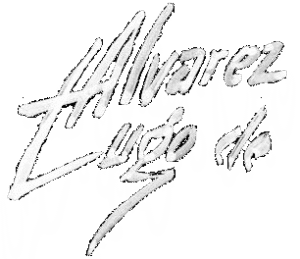
[Page 1] SELF-PORTRAIT From December 11 to 31, 1966 ARMANDO REVERÓN HALL FOUNDER: ADRIANO SERRADIMISI Avenida El Ávila, Avda. Los Jabillos, Centro Comercial La Florida. Phone: 715001. Caracas, Venezuela Luis Álvarez de Lugo
[Page 2] On April 23, 1923, the talented artist Luis Álvarez de Lugo was born in Caracas. In that distant era, the beautiful four-hundred-year-old capital preserved its colonial placidity. His parents observed their son’s artistic and ancestral vein and enrolled him in the “School of Plastic Arts of Caracas,” under the direction of the portrait professor Martín Durbán. Luis immediately showed his inclination for portraiture. It is known that thousands of portraitists exist in the world, but it is difficult to find a good one who can execute a likeness and the traits that characterize an individual’s personality with an optical vision of seconds; Luis Álvarez de Lugo is one of them, and is at once a good draftsman and landscape painter. Precious are his oil paintings of old Caracas.
Their beautiful coloring makes one long for that conventual city, so lovely and quiet. The movement of the painting is rhythmic and cheerful, much like its forests and streams, and the coloring is superb like its gardens and flowers. In his portraits and his Caracas themes, the artist Álvarez de Lugo grows greater and greater. We have the example when observing his self-portrait and the oil painting of the remembered Raúl Santana. In these paintings, a vigorous and clean skill is noted.
For the most part, his creations fall within Impressionist painting. Luis has the great peculiarity of seeking colors pleasant to the eyes and playing with them, as he does in his self-portrait, with ultramarine blue, viridian, cadmium yellow, burnt sienna, and umber. He joins these colors with other complementary ones and begins, upon the stage of the canvas, the beautiful dance of ranges that grow, diminish, and flutter around amidst glows and shadows; waterfalls of light stand out on the right, making the brushstrokes—shaped like layers—dance among diverse tones to impart plasticity.
Artists of the caliber of Luis Álvarez de Lugo know that various light sources destroy form. The artist becomes entranced with shadows and harmonizes contrasts with his warm or cold complementaries. This thematic approach is similar to that of Frans Hals, especially when he begins with fine brushes a psychological probe, only to define with a single strong and swept impact the characteristic trait he desires—whether in the lady with a kind gaze or in the politician, the industrialist, or the bohemian.
In his self-portrait, with strong and swept brushstrokes near the eyes, he defines and at once specifies his tenacity with a lost and absorbed gaze. Álvarez de Lugo looks into the mirror, seeking an effective glow to finish his work. All ladies should be happy to know that in Caracas there is an excellent portraitist. In these models, he uses virtuosity, which gives grace and beauty to all women. The portrait of Mrs. Blanquita Henríquez de Azpúrua is exquisite, without Luis having strayed from objective truth. Men should also know that we have a defined painter who, with a single brushstroke, achieves the essential impact and obtains soulful manifestations. I feel satisfied for Luis Álvarez de Lugo having chosen me to present him in this excellent show, as I am certain his exhibition will be a success.
DOMINGO ALFREDO RICCI Caracas, December 12, 1966
CATALOG
| # | Title | Medium |
| 1 | SIMÓN BOLÍVAR, CIVIL | Crayon |
| 2 | MILKMEN | Oil |
| 3 | CONVENT OF SAN JACINTO | Oil |
| 4 | CORNER OF PRINCIPAL | Oil |
| 5 | SAN FRANCISCO | Oil |
| 6 | ORATORY OF SAN FELIPE NERI | Oil |
| 7 | SOCIEDAD A CAMEJO | Oil |
| 8 | CHACAÍTO | Oil |
| 9 | MACUTO BOARDWALK | Oil |
| 10 | CORNER OF EL CHORRO | Oil |
| 11 | BAKER | Oil |
| 12 | CARRIAGE STOP | Oil |
| 13 | CORPUS PROCESSION | Oil |
| 14 | CEMETERY OF THE CHILDREN OF GOD | Oil |
| 15 | WAITING FOR THE DETOUR | Oil |
| 16 | CARACAS PATIO | Pastel |
| 17 | DANCING DEVIL | Oil |
| 18 | DEVILS IN THE PLAZA | Oil |
| 19 | FISHERMAN’S FAMILY (TACARIGUA) | Oil |
| 20 | YOUNG HEIFER (BECERRITA) | Oil |
| 21 | REFLECTIONS | Oil |
| 22 | GAÑANGO (PUERTO CABELLO) | Oil |
| 23 | RAÚL SANTANA | Oil |
| 24 | BLANQUITA HENRÍQUEZ DE AZPÚRUA | Oil |
| 25 | MONOCHROME (MOROCHO) | Pastel |
| 26 | SELF-PORTRAIT | Oil |
Transcripción Original (Español)
[PÁGINA 1]
AUTORRETRATO Del 11 al 31 de diciembre de 1966 SALA ARMANDO REVERÓN FUNDADOR ADRIANO SERRADIMISI Avenida El Avila, Avda. Los Jabillos Centro Comercial La Florida Teléf 715001 Caracas, Venezuela Luis Alvarez de Lugo
[PÁGINA 2] EL DÍA 23 de abril de 1923, nació en Caracas el talentoso artista Luis Alvarez de Lugo. En aquella época lejana, la linda capital cuatricentenaria conservaba la placidez colonial. Sus progenitores observaron la vena artística y atávica del hijo y lo inscribieron en la “Escuela de Artes Plásticas de Caracas”, bajo la dirección del profesor retratista Martin Durbán. Luis demostró inmediatamente su inclinación por el retrato. Se sabe que en el mundo existen miles de retratistas, pero es difícil encontrar uno bueno, que pueda ejecutar con visión óptica de segundos el parecido, y los rasgos que caracterizan la personalidad del individuo, y Luis Alvarez de Lugo es uno de ellos y es a la vez buen dibujante y paisajista. Preciosos son los óleos de la Caracas antañona.
Su hermoso colorido hace añorar aquella conventual ciudad, tan linda y tranquila. El movimiento de la pintura es cantarino y alegre, tal como sus bosques y sus riachuelos y el colorido soberbio como sus jardines y sus flores. En sus retratos y en sus temas caraqueños el artista Alvarez de Lugo se agiganta más y más. El ejemplo lo tenemos al observar su autorretrato y el óleo del recordado Raúl Santana. En estas pinturas se nota la habilidad vigorosa y limpia.
En mayoría, sus creaciones están dentro de la pintura impresionista. Luis tiene la gran peculiaridad de buscar para los ojos colores agradables y juguetear con ellos, tal como lo hace en su autorretrato, con el azul ultramar, el viridian, el amarillo-cadmio, el siena tostada y sombra. Estos colores los une a otros complementarios y comienza en el escenario del lienzo, la hermosa danza de gamas que se agigantan, se disminuyen y revolotean alrededor entre resplandores y sombras, sobresaliendo a la derecha cataratas de luces, éstas hacen que los pincelazos con formas de napas bailen entre tonalidades diversas para imprimir plasticidad.
Los artistas de la talla de Luis Alvarez de Lugo, saben que varias fuentes de luz destruyen la forma. El artista se extasía con las sombras, y armoniza los contrastes, con sus complementarios cálidos o fríos. Esta temática es parecida a la de Frans Hals, y más cuando comienza con pinceles finos un sondeo psicológico, para definir con un solo impacto fuerte y barrido el rasgo característico que desea, tanto en la dama de mirada bondadosa, como en el político, el industrial o el bohemio.
En su autorretrato de brochazos fuertes y barridos cerca de los ojos, define y a la vez precisa su tesón con la mirada perdida y absorta. Alvarez de Lugo busca en el espejo, que se mira un fulgor efectivo para terminar su labor. Todas las damas deben de estar contentas al saber que en Caracas hay un excelente retratista. En estos modelos usa el virtuosismo, que da gracia y belleza a todas las mujeres. El retrato de la señora Blanquita Henriquez de Azpúrua es primoroso, sin que Luis se haya alejado de la veracidad objetiva. También los hombres deben de saber que tenemos un pintor definido que, con un brochazo consigue el impacto esencial y obtiene las manifestaciones anímicas. Me siento satisfecho por haberme elegido Luis Alvarez de Lugo para presentarlo en esta excelente muestra, ya que tengo la seguridad que su exposición será un éxito.
DOMINGO ALFREDO RICCI Caracas, 12 de diciembre de 1966
CATALOGO
| # | Obra | Técnica |
| 1 | SIMÓN BOLÍVAR, CIVIL | Creyón |
| 2 | LECHEROS | Óleo |
| 3 | CONVENTO DE SAN JACINTO | Óleo |
| 4 | ESQUINA DE PRINCIPAL | Óleo |
| 5 | SAN FRANCISCO | Óleo |
| 6 | ORATORIO SAN FELIPE NERI | Óleo |
| 7 | SOCIEDAD A CAMEJO | Óleo |
| 8 | CHACAÍTO | Óleo |
| 9 | MALECÓN DE MACUTO | Óleo |
| 10 | ESQUINA DEL CHORRO | Óleo |
| 11 | PANADERO | Óleo |
| 12 | PARADA DE COCHES | Óleo |
| 13 | PROCESIÓN DE CORPUS | Óleo |
| 14 | CEMENTERIO DE LOS HIJOS DE DIOS | Óleo |
| 15 | ESPERANDO EL DESVÍO | Óleo |
| 16 | PATIO CARAQUEÑO | Pastel |
| 17 | DIABLO DANZANTE | Óleo |
| 18 | DIABLOS EN LA PLAZA | Óleo |
| 19 | FAMILIA DE PESCADOR (TACARIGUA) | Óleo |
| 20 | BECERRITA | Óleo |
| 21 | REFLEJOS | Óleo |
| 22 | GAÑANGO (PUERTO CABELLO) | Óleo |
| 23 | RAÚL SANTANA | Óleo |
| 24 | BLANQUITA HENRÍQUEZ DE AZPÚRUA | Óleo |
| 25 | MOROCHO | Pastel |
| 26 | AUTORRETRATO | Óleo |