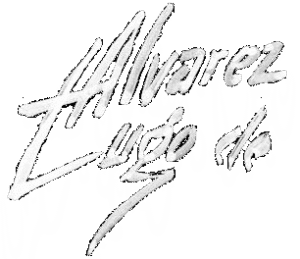

Luis Guillermo Alvarez de Lugo Santana (Caracas, Venezuela, April 23, 1923 – January 24, 2019) was a Venezuelan painter, draftsman, illustrator, and sculptor, and a prominent figure in figurative realism rooted in the Caracas landscape tradition. Over a career spanning more than seven decades (1938–2013), he earned critical acclaim for his oil landscapes, dynamic equestrian studies, portraiture, female figures, and visual chronicles of historic Caracas.
Born into the Alvarez de Lugo family, he was the son of Tulio Alvarez de Lugo e Isava and Olga Santana Müller, growing up alongside his brothers and sisters in Sabana Grande. His father, Tulio Alvarez de Lugo (born in Caracas in 1892), was a pioneer of Venezuelan cinema whose surviving reels preserve some of the country’s earliest moving images. In 1942, Luis met Beatriz Azpúrua, whom he married in 1945; together they shared over seventy years of marriage and raised six children. (Parents Photo · Siblings · Cinema Archive)


Early Guidance & Formal Training (1941–1950s)

He received his earliest artistic guidance at home from his maternal uncle Raúl Santana (Raúl Santana Moller), a founding member of the Círculo de Bellas Artes de Caracas and creator of the Museo Criollo Raúl Santana. In 1941, he entered the School of Plastic Arts of Caracas under Spanish master Ramón Martín Durbán, specializing in figure and portraiture. By 1942, he was exhibiting bullfighting watercolors in Caracas, drawing praise in La Esfera for his technical looseness and movement.

In 1950, he broadened his training in the United States by completing the three-year Famous Artists Course in Westport, Connecticut, studying the methods of Ben Stahl, Stephen Dohanos, Austin Briggs, and Norman Rockwell. Critics defined his resulting language as ‘creative realism’ (realismo creador), uniting classical drawing precision with neo-impressionist light and color. Before dedicating himself exclusively to painting around 1960, he worked as a technical draftsman for oil companies and Venezuela’s Ministry of Mines.
Cultural Preservation & Editorial Work
Beyond the canvas, Alvarez de Lugo founded and presided over Fotociencia S.A. In 1958, he led the landmark facsimile restoration and reissue of the 19th-century magazine El Cojo Ilustrado, followed by the rescue of José Martí’s Revista Venezolana (1881). In 1961, he illustrated El Rosario para colorear with the imprimatur of Cardinal José Humberto Quintero. He also illustrated historical books by Caracas chronicler Guillermo José Schael (La Ciudad que no vuelve, 1974; El Vecindario de Simón Bolívar, 1984), drew the portrait of Andrés Mata for El Universal’s 60th-anniversary book (1969), and designed the 1978 LP cover for harpist Juan Vicente Torrealba (Radio Rumbos).
Institutional Portraiture, International Exhibitions & Honors

Following his 1964 solo debut at the Sala Armando Reverón and a portrait of President John F. Kennedy exhibited at the U.S. Embassy in Caracas, he painted major institutional portraits—including Bolívar Civil for the National Academy of Medicine (1965), portraits for the Palacio de Miraflores, Casa Boulton, and Valencia International Airport (1970). In 1983, his acrylic Simon Bolivar 1783–1830 was presented by Venezuela to the Parliament of the United Kingdom (Parliamentary Art Collection, London), alongside a portrait of General San Martín gifted to Argentina. Later commissions included Dr. Arnoldo Gabaldón (2006) and the founders of the National Academy of Economic Sciences (2011).
In June 1973, his solo show of 27 oils at Galerie Marcel Bernheim in Paris earned widespread French critical acclaim, a French television documentary, and entry into the 1974 Official Guide of Paris Galleries. In Venezuela, he won the Paleta de Oro at the XII Armando Reverón National Salon (1976), served on the board of the Museum of Transport (staging ‘Memoria de la ciudad’ in 1986), and received the Order of Diego de Losada, First Class (1980).
Apollo 11 Stamp, El Ávila, Bronze Sculpture & Teaching
In 1969, he designed Venezuela’s commemorative Apollo 11 postal stamp (1,000,000 printed in Finland; featured on the cover of New York’s STAMPS magazine) and co-founded the Parque del Este Painting Salon. Known for painting over a hundred canvases of Cerro El Ávila (with a 1994 monographic show), he also turned to cast bronze sculpture in Sarasota, Florida in 1980, debuting equestrian and polo bronzes at Galerie J. Lavigne in Palm Beach (1984; auctioned at Weschler’s, Washington D.C., 2009). Throughout his life, he dedicated two days a week for over 45 years to teaching drawing and painting from his workshop. (Apollo 11 Stamp Details)
Interactive Timeline (1923–2019)
Official Documentary & External References
Explore Paintings | Exhibitions History | Wikipedia Entry (ES)