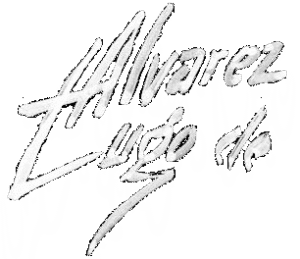

The international art critic Raymond Charmet, author of the Modern Dictionary edited by Larousse, wrote on the artist’s 1973 Paris exhibition: “Reality is not always realistic with the ferocity that such a word implies. He who possesses science and tact to master and control it reveals wonderful facets of freshness and enchanting beauty. It took an artist from such a privileged country as Venezuela to remind us of that. Such is the great achievement of Alvarez de Lugo: to give his art the milk of human tenderness, as Shakespeare would say.”
Raymond Charmet, Paris, 1973
“Luis Alvarez de Lugo uses in his paintings a realistic language, through landscape, flowers and portraits, filling them with life and luminous blooms of light and color akin to Tito Salas or the Spanish school of Zuloaga, López Mezquita and Álvarez Sotomayor. Yet as a man of his time, he modernizes this style with figurative realism that weaves contemporary expression into the traditional.”
Santiago Magariños, Universidad Central de Venezuela, 1968
“Alvarez de Lugo, a figurative painter, is an artist in the fullest sense of the word. Quietly and without publicity stunts, he devotes himself entirely to his work: serene female figures seen through an exacting creative realism and landscapes of his beloved Caracas. An academic painter, disciple of that great master and draftsman Ramón Martín Durbán.”
Oscar Rojas Jiménez, El Universal, Dec 29, 1968
“Alvarez de Lugo remains faithful to the figurative genre and to this neo-impressionist style he has made unmistakably his own, expressing with spontaneity, vitality, and clarity every subject within a genuinely national landscape.”
Adolfo Romero Luengo, 1971
“In time, the painter’s works will endure as an illustrative testimony of an era, bearing unquestionable authenticity—so that it may be said that every painting by Alvarez de Lugo is a clear, direct, and truthful reflection of his times and society.”
Rafael Páez (Pintores Venezolanos, 1972)
“From Venezuela, where he is a celebrated artist, his painting captures the simple and subtle charm of his country. Grandiose nature turned into sweetness and harmony, figures of grace—Alvarez de Lugo evokes all these subjects in an impressionist realism where taste and craft unite masterfully.”
Raymond Charmet, Paris, 1978