English Translation
BRUJULA (Compass)
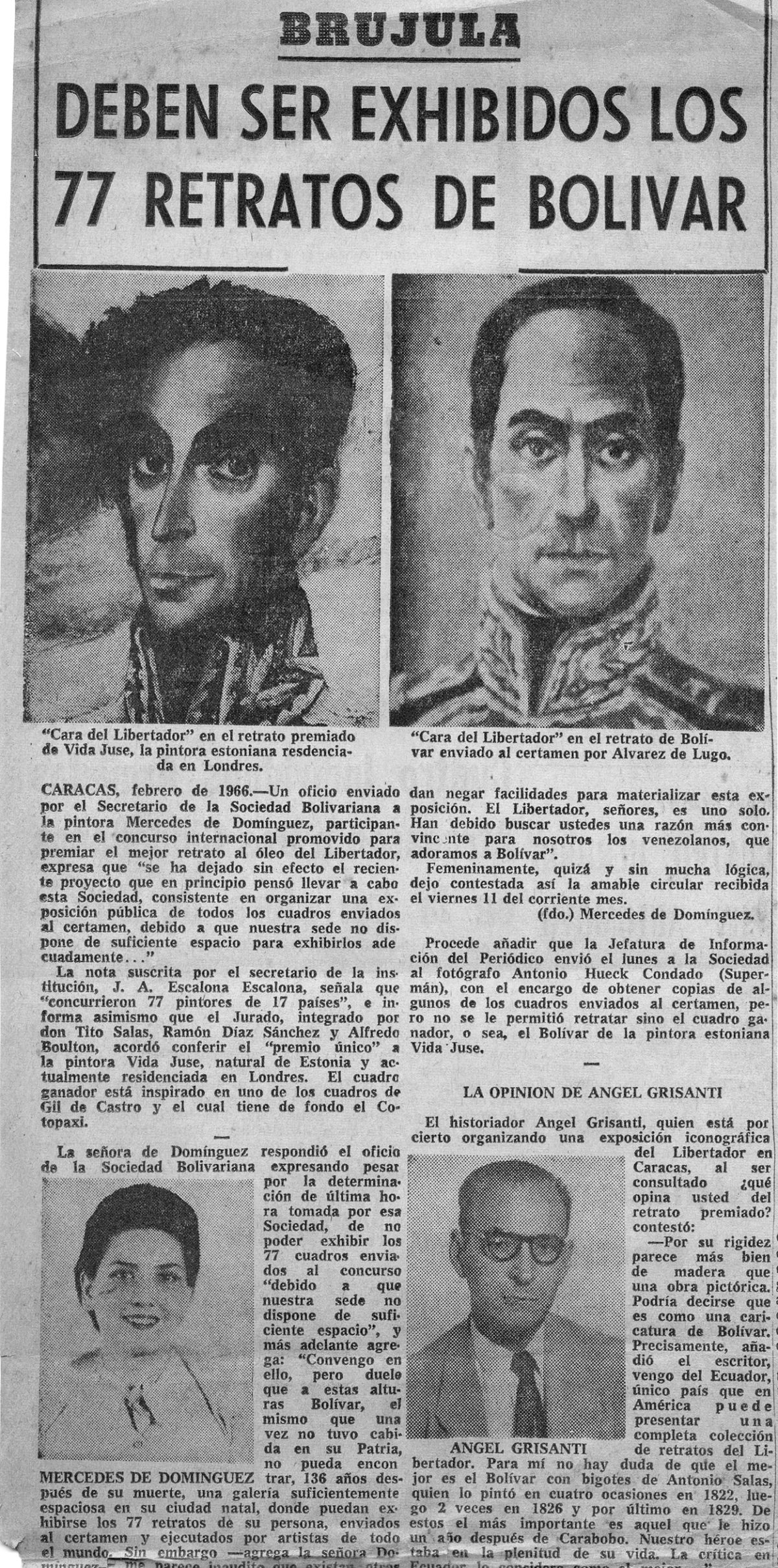
THE 77 PORTRAITS OF BOLIVAR MUST BE EXHIBITED
Left Image Caption: “Face of the Liberator” in the prize-winning portrait by Vida Juse, the Estonian painter residing in London. Right Image Caption: “Face of the Liberator” in the portrait of Bolivar sent to the contest by Alvarez de Lugo.
CARACAS, February 1966.—An official letter sent by the Secretary of the Bolivarian Society to the painter Mercedes de Domínguez, a participant in the international competition promoted to award the best oil portrait of the Liberator, states that “the recent project that the Society originally intended to carry out, consisting of organizing a public exhibition of all the paintings sent to the contest, has been canceled, because our headquarters does not have sufficient space to exhibit them adequately…”
The note signed by the secretary of the institution, J. A. Escalona Escalona, indicates that “77 painters from 17 countries participated,” and also reports that the Jury, composed of Tito Salas, Ramón Díaz Sánchez, and Alfredo Boulton, agreed to confer the “sole prize” to the painter Vida Juse, a native of Estonia and currently residing in London. The winning painting is inspired by one of the paintings by Gil de Castro and has Cotopaxi in the background.
Mrs. de Domínguez responded to the official letter from the Bolivarian Society expressing regret for the last-minute decision taken by said Society not to be able to exhibit the 77 paintings sent to the contest “due to the fact that our headquarters does not have sufficient space,” and further ahead she adds: “I agree with this, but it hurts that at this stage Bolivar, the same one who once had no place in his Homeland, after 136 years since his death, cannot find a sufficiently large gallery in his native city where the 77 portraits of his person can be exhibited, sent to the contest and executed by artists from all over the world. However—adds Mrs. Domínguez—it seems unheard of to me that facilities are denied to materialize this exhibition. The Liberator, gentlemen, is only one. You must have looked for a more convincing reason for us Venezuelans, who adore Bolivar.”
Femininely, perhaps and without much logic, the kind circular received on Friday the 11th of the current month was thus left answered. (sd.) Mercedes de Domínguez.
It is worth adding that the Editorial Office of the Newspaper sent photographer Antonio Hueck Condado (Superman) on Monday to the Bolivarian Society, with the task of obtaining copies of some of the paintings sent to the contest, but he was only allowed to photograph the winning painting, that is, the Bolivar by the Estonian painter Vida Juse.
THE OPINION OF ANGEL GRISANTI
The historian Angel Grisanti, who is currently organizing an iconographic exhibition of the Liberator in Caracas, when consulted on what he thinks of the winning portrait, replied:
—Due to its rigidity, it looks more like it’s made of wood than a pictorial work. It could be said that it is like a caricature of Bolivar. Precisely, added the writer, I come from Ecuador, the only country that in America can present a complete collection of portraits of the Liberator. For me, there is no doubt that the best is the Bolivar with a mustache by Antonio Salas, who painted him on four occasions in 1822, then twice in 1826 and finally in 1829. Of these, the most important is the one he made after Carabobo. Our hero was in the prime of his life. Criticism in Ecuador considers it the best.
Portrait Caption: MERCEDES DE DOMINGUEZ Portrait Caption: ANGEL GRISANTI
Transcripción en Español
BRUJULA
DEBEN SER EXHIBIDOS LOS 77 RETRATOS DE BOLIVAR
Leyenda Imagen Izquierda: “Cara del Libertador” en el retrato premiado de Vida Juse, la pintora estoniana residenciada en Londres. Leyenda Imagen Derecha: “Cara del Libertador” en el retrato de Bolívar enviado al certamen por Alvarez de Lugo.
CARACAS, febrero de 1966.—Un oficio enviado por el Secretario de la Sociedad Bolivariana a la pintora Mercedes de Domínguez, participante en el concurso internacional promovido para premiar el mejor retrato al óleo del Libertador, expresa que “se ha dejado sin efecto el reciente proyecto que en principio pensó llevar a cabo esta Sociedad, consistente en organizar una exposición pública de todos los cuadros enviados al certamen, debido a que nuestra sede no dispone de suficiente espacio para exhibirlos adecuadamente…”
La nota suscrita por el secretario de la institución, J. A. Escalona Escalona, señala que “concurrieron 77 pintores de 17 países”, e informa asimismo que el Jurado, integrado por don Tito Salas, Ramón Díaz Sánchez y Alfredo Boulton, acordó conferir el “premio único” a la pintora Vida Juse, natural de Estonia y actualmente residenciada en Londres. El cuadro ganador está inspirado en uno de los cuadros de Gil de Castro y el cual tiene de fondo el Cotopaxi.
La señora de Domínguez respondió el oficio de la Sociedad Bolivariana expresando pesar por la determinación de última hora tomada por esa Sociedad, de no poder exhibir los 77 cuadros enviados al concurso “debido a que nuestra sede no dispone de suficiente espacio”, y más adelante agrega: “Convengo en ello, pero duele que a estas alturas Bolívar, el mismo que una vez no tuvo cabida en su Patria, tras 136 años después de su muerte, no pueda encontrar una galería suficientemente espaciosa en su ciudad natal, donde puedan exhibirse los 77 retratos de su persona, enviados al certamen y ejecutados por artistas de todo el mundo. Sin embargo —agrega la señora Domínguez— me parece inaudito que se nieguen facilidades para materializar esta exposición. El Libertador, señores, es uno solo. Han debido buscar ustedes una razón más convincente para nosotros los venezolanos, que adoramos a Bolívar”.
Femeninamente, quizá y sin mucha lógica, dejó contestada así la amable circular recibida el viernes 11 del corriente mes. (fdo.) Mercedes de Domínguez.
Procede añadir que la Jefatura de Información del Periódico envió el lunes a la Sociedad al fotógrafo Antonio Hueck Condado (Supermán), con el encargo de obtener copias de algunos de los cuadros enviados al certamen, pero no se le permitió retratar sino el cuadro ganador, o sea, el Bolívar de la pintora estoniana Vida Juse.
LA OPINION DE ANGEL GRISANTI
El historiador Angel Grisanti, quien está por cierto organizando una exposición iconográfica del Libertador en Caracas, al ser consultado ¿qué opina usted del retrato premiado? contestó:
—Por su rigidez parece más bien de madera que una obra pictórica. Podría decirse que es como una caricatura de Bolívar. Precisamente, añadió el escritor, vengo del Ecuador, único país que en América puede presentar una completa colección de retratos del Libertador. Para mí no hay duda de que el mejor es el Bolívar con bigotes de Antonio Salas, quien lo pintó en cuatro ocasiones en 1822, luego 2 veces en 1826 y por último en 1829. De estos el más importante es aquel que le hizo después de Carabobo. Nuestro héroe estaba en la plenitud de su vida. La crítica en el Ecuador lo considera como el mejor.
Leyenda Retrato: MERCEDES DE DOMINGUEZ Leyenda Retrato: ANGEL GRISANTI