English Translation
Cuatricentennial Painting
Retrospective Image of Caracas to be Presented on the 11th by Alvarez de Lugo
By RAFAEL GINARI
CARACAS, Dec. 1966.— The renowned artist Luis Alvarez de Lugo will offer to the consideration of the capital’s public next Sunday, December 11, in the “Armando Reverón” Hall, a picturesque and evocative exhibition to celebrate the Cuatricentennial of Caracas and in memory of his uncle, the late Caracas native Raúl Santana. There, he manages to capture with realism, emotion, and figurative technique, all the flavor of “end of the century” Caracas.
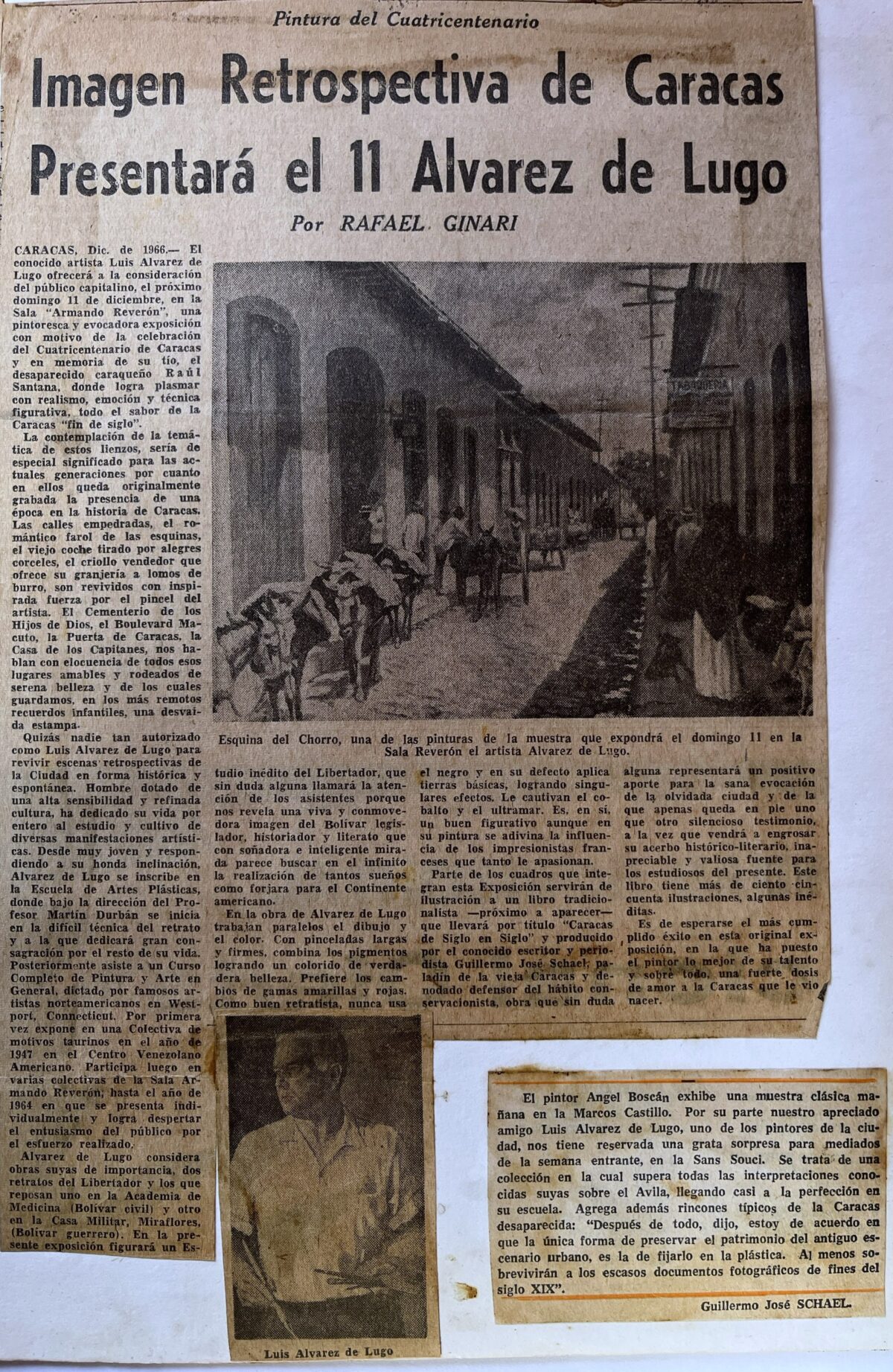
Contemplating the themes of these canvases will be of special significance for current generations, as they originally record the presence of an era in the history of Caracas. The cobbled streets, the romantic lantern on the corners, the old carriage pulled by joyful steeds, the local vendor offering his goods on donkey-back, are revived with inspired strength by the artist’s brush. The Cemetery of the Sons of God, the Macuto Boulevard, the Gate of Caracas, the House of the Captains, speak to us with eloquence of all those pleasant places surrounded by serene beauty, of which we keep, in our most remote childhood memories, a faded image.
Perhaps no one is as authorized as Luis Alvarez de Lugo to revive retrospective scenes of the City in a historical and spontaneous way. A man endowed with high sensitivity and refined culture, he has dedicated his life entirely to the study and cultivation of various artistic manifestations. From a very young age, Alvarez de Lugo enrolled in the School of Plastic Arts, where under the direction of Professor Martin Durbán, he began the difficult technique of portraiture, to which he would dedicate great devotion for the rest of his life. Later, he attended a Complete Course in Painting and Art in General, taught by famous North American artists in Westport, Connecticut. He exhibited for the first time with bullfighting motifs in 1947 at the Venezuelan-American Center. He then participated in various collective exhibitions at the Armando Reverón Hall until 1964, when he presented himself individually and managed to awaken the public’s enthusiasm for the effort achieved.
Alvarez de Lugo considers as his other important works two portraits of the Liberator: those resting in the Academy of Medicine (Bolívar civil) and in the Military House, Miraflores (Bolívar warrior). In the current exhibition, an unpublished study of the Liberator will be featured, which will undoubtedly draw the attention of those attending because it reveals a vivid and moving image of Bolívar as legislator, historian, and man of letters, who with a dreamy and intelligent gaze seems to search the infinite for the realization of so many dreams he forged for the American Continent.
In Alvarez de Lugo’s work, drawing and color work in parallel. With long, firm brushstrokes, he combines pigments achieving a coloring of true beauty. He prefers ranges of yellows and reds. As a good portraitist, he never uses black; instead, he applies basic earths, achieving singular effects. He is captivated by cobalt and ultramarine. In essence, a good figurative artist, although in his painting one can sense the influence of the French Impressionists he is so passionate about.
Part of the paintings forming this exhibition will serve as illustrations for a traditionalist book—soon to appear—titled “Caracas from Century to Century,” produced by the well-known writer and journalist Guillermo José Schael, a staunch defender of the preservationist habit. This work will undoubtedly represent a positive contribution to the healthy evocation of the forgotten city and of which barely one or another silent testimony remains standing, which will now join its historical-literary heritage—an appreciable and valuable source for today’s scholars. This book has more than one hundred and fifty illustrations, some unpublished.
The most fulfilled success is expected in this original exhibition, in which the painter has put the best of his talent and, above all, a strong dose of love for the Caracas that saw him born.
[Caption under the main image]: Esquina del Chorro, one of the paintings in the exhibition that artist Alvarez de Lugo will present this Sunday the 11th in the Reverón Hall.
[Caption under the portrait]: Luis Alvarez de Lugo.
[Side Note by Guillermo José Schael]: The painter Angel Boscán is exhibiting a classic show tomorrow at the Castillo Market. For his part, our esteemed friend Luis Alvarez de Lugo, one of the city’s painters, has a surprise reserved for us in mid-week at the Sans Souci. It is a collection in which he surpasses all his known interpretations of the Avila, reaching almost perfection in his school. He also adds typical corners of the disappeared Caracas: “After all, I agree that the only way to preserve the heritage of the old urban setting is to fix it in plastic arts. At least they will outlive the scarce photographic documents of the late 19th century.”
Original en Español
Pintura del Cuatricentenario
Imagen Retrospectiva de Caracas Presentará el 11 Alvarez de Lugo
Por RAFAEL GINARI
CARACAS, Dic. de 1966.— El conocido artista Luis Alvarez de Lugo ofrecerá a la consideración del público capitalino, el próximo domingo 11 de diciembre, en la Sala “Armando Reverón”, una pintoresca y evocadora exposición con motivo de la celebración del Cuatricentenario de Caracas y en memoria de su tío, el desaparecido caraqueño Raúl Santana, donde logra plasmar con realismo, emoción y técnica figurativa, todo el sabor de la Caracas “fin de siglo”.
La contemplación de la temática de estos lienzos, sería de especial significado para las actuales generaciones por cuanto en ellos queda originalmente grabada la presencia de una época en la historia de Caracas. Las calles empedradas, el romántico farol de las esquinas, el viejo coche tirado por alegres corceles, el criollo vendedor que ofrece su granjería a lomos de burro, son revividos con inspirada fuerza por el pincel del artista. El Cementerio de los Hijos de Dios, el Boulevard Macuto, la Puerta de Caracas, la Casa de los Capitanes, nos hablan con elocuencia de todos esos lugares amables y rodeados de serena belleza y de los cuales guardamos, en los más remotos recuerdos infantiles, una desvaída estampa.
Quizás nadie tan autorizado como Luis Alvarez de Lugo para revivir escenas retrospectivas de la Ciudad en forma histórica y espontánea. Hombre dotado de una alta sensibilidad y refinada cultura, ha dedicado su vida por entero al estudio y cultivo de diversas manifestaciones artísticas. Desde muy joven y respondiendo a su honda inclinación, Alvarez de Lugo se inscribe en la Escuela de Artes Plásticas, donde bajo la dirección del Profesor Martín Durbán se inicia en la difícil técnica del retrato y a la que dedicará gran consagración por el resto de su vida. Posteriormente asiste a un Curso Completo de Pintura y Arte en General, dictado por famosos artistas norteamericanos en Westport, Connecticut. Por primera vez expone en una Colectiva de motivos taurinos en el año de 1947 en el Centro Venezolano Americano. Participa luego en varias colectivas de la Sala Armando Reverón, hasta el año de 1964 en que se presenta individualmente y logra despertar el entusiasmo del público por el esfuerzo realizado.
Alvarez de Lugo considera otras suyas de importancia, dos retratos del Libertador y los que reposan uno en la Academia de Medicina (Bolívar civil) y otro en la Casa Militar, Miraflores, (Bolívar guerrero). En la presente exposición figurará un Estudio inédito del Libertador, que sin duda alguna llamará la atención de los asistentes porque nos revela una viva y conmovedora imagen del Bolívar legislador, historiador y literato que con soñadora e inteligente mirada parece buscar en el infinito la realización de tantos sueños como forjara para el Continente americano.
En la obra de Alvarez de Lugo trabajan paralelos el dibujo y el color. Con pinceladas largas y firmes, combina los pigmentos logrando un colorido de verdadera belleza. Prefiere las gamas de gamas amarillas y rojas. Como buen retratista, nunca usa el negro y en su defecto aplica tierras básicas, logrando singulares efectos. Le cautivan el cobalto y el ultramar. Es, en sí, un buen figurativo aunque en su pintura se adivina la influencia de los impresionistas franceses que tanto le apasionan.
Parte de los cuadros que integran esta Exposición servirán de ilustración a un libro tradicionalista —próximo a aparecer— que llevará por título “Caracas de Siglo en Siglo” y producido por el conocido escritor y periodista Guillermo José Schael; paladín de la vieja Caracas y denodado defensor del hábito conservacionista, obra que sin duda alguna representará un positivo aporte para la sana evocación de la olvidada ciudad y de la que apenas queda en pie uno que otro silencioso testimonio, a la vez que vendrá a engrosar su acerbo histórico-literario, inapreciable y valiosa fuente para los estudiosos del presente. Este libro tiene más de ciento cincuenta ilustraciones, algunas inéditas.
Es de esperarse el más cumplido éxito en esta original exposición, en la que ha puesto el pintor lo mejor de su talento y sobre todo, una fuerte dosis de amor a la Caracas que le vio nacer.
[Pie de foto principal]: Esquina del Chorro, una de las pinturas de la muestra que expondrá el domingo 11 en la Sala Reverón el artista Alvarez de Lugo.
[Pie de foto retrato]: Luis Alvarez de Lugo.
[Nota lateral de Guillermo José Schael]: El pintor Angel Boscán exhibe una muestra clásica mañana en la Marcos Castillo. Por su parte nuestro apreciado amigo Luis Alvarez de Lugo, uno de los pintores de la ciudad, nos tiene reservada una grata sorpresa para mediados de la semana entrante, en la Sans Souci. Se trata de una colección en la cual supera todas las interpretaciones conocidas suyas sobre el Avila, llegando casi a la perfección en su escuela. Agrega además rincones típicos de la Caracas desaparecida: “Después de todo, dijo, estoy de acuerdo en que la única forma de preservar el patrimonio del antiguo escenario urbano, es la de fijarlo en la plástica. Al menos sobrevivirán a los escasos documentos fotográficos de fines del siglo XIX”.