English Translation
Caracas, November 29th 1966
Las Artes en el Cuatricentenario
Painter Luis Alvarez de Lugo Will Present an Exhibition of Caracas Before the Oil Era
Twenty retrospective works on December 11 at the “Sala Reverón”
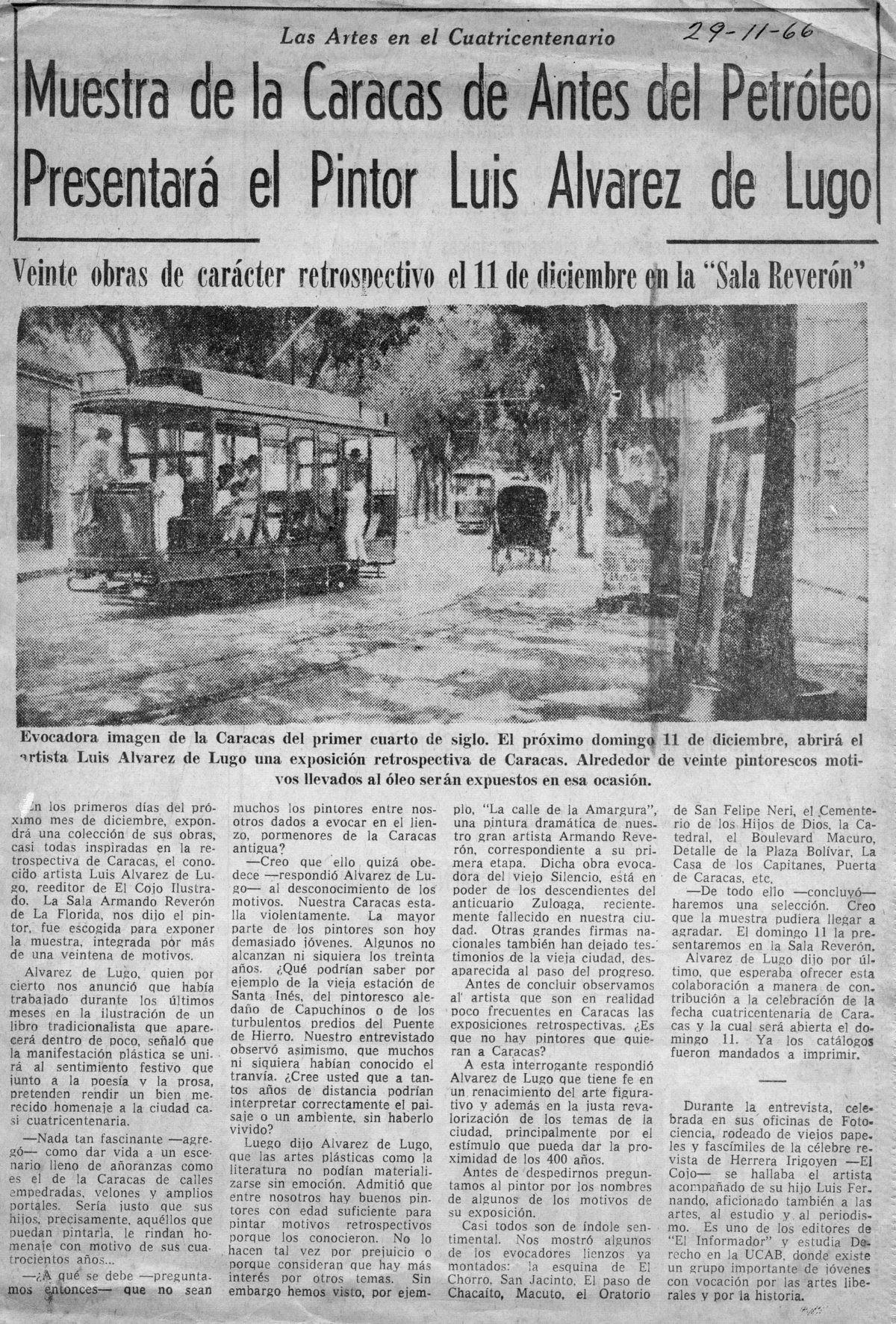
(Caption under the photo): Evocative image of Caracas from the first quarter of the century. Next Sunday, December 11, the artist Luis Alvarez de Lugo will open a retrospective exhibition of Caracas. Around twenty picturesque motifs painted in oil will be exhibited on that occasion.
In the early days of next December, the well-known artist Luis Alvarez de Lugo, editor of El Cojo Ilustrado, will exhibit a collection of his works, almost all inspired by the retrospection of Caracas. The “Sala Armando Reverón” in La Florida, the painter told us, was chosen to exhibit the show, composed of more than twenty motifs.
Alvarez de Lugo, who by the way announced to us that he had worked during the last months on the illustration of a traditionalist book that will appear shortly, pointed out that the visual arts join the festive sentiment that, together with poetry and prose, intend to pay a well-deserved tribute to the city on its quadricentennial.
—Nothing as fascinating —he added— as giving life to a stage full of yearnings such as that of Caracas with cobbled streets, oil lamps, and wide portals. It would be fair for those who can paint it to pay tribute to it on the occasion of its four hundred years…
—To what is it due —we then asked— that there are not many painters among us dedicated to evoking on canvas details of old Caracas?
—I believe that this is perhaps due —replied Alvarez de Lugo— to the lack of knowledge of the motifs. Our Caracas is changing violently. Most painters today are too young. Some do not even reach thirty years of age. What could they know, for example, about the old Santa Inés station, the picturesque area of Capuchinos, or the turbulent settings of the Iron Bridge (Puente de Hierro)? Our interviewee also observed that many had not even known the tram. Do you believe that so many years of distance could correctly interpret the landscape or an atmosphere without having lived it?
Then Alvarez de Lugo said that plastic arts, like literature, could not materialize without emotion. He admitted that among us there are good painters old enough to paint retrospective motifs because they knew them. They do not do so perhaps out of prejudice or because they consider that there is more interest in other themes. However, we have seen, for example, “La calle de la Amargura”, a dramatic painting of ours, by the great artist Armando Reverón, corresponding to his first stage. Said work, evocative of the old El Silencio, is in the possession of the descendants of the antiquarian Zuloaga, recently deceased in our city. Other great national figures have also left testimonies of the old city, disappeared by the passage of progress.
Before concluding, we observed to the artist that retrospective exhibitions are actually rare in Caracas. Is it that there are no painters who want to look back at Caracas?
To this question, Alvarez de Lugo responded that he has faith in a rebirth of figurative art and also in the fair revaluation of the city’s themes, mainly due to the stimulus that the proximity of the 400 years can provide.
Before saying goodbye, we asked for the names of some of the motifs of his exhibition.
Almost all are of a sentimental nature. He showed us some of the evocative canvases already mounted: the corner of El Chorro, San Jacinto, the pass of Chacaíto, Macuto, the Oratory of San Felipe Neri, the cemetery of the Sons of God (Hijos de Dios), the Cathedral, Boulevard Macuro, detail of Plaza Bolívar, the House of the Captains, the Gate of Caracas, etc.
—From all of this —he concluded— we will make a selection. I believe that the sample could be liked. On Sunday the 11th we will present it in the Sala Reverón.
Alvarez de Lugo said finally that he hoped to offer this collaboration as a contribution to the celebration of the quadricentennial date of Caracas and which will be opened on Sunday 11. The catalogs have already been sent to be printed.
During the interview, held in his offices of Fotociencia, surrounded by old papers and facsimiles of the famous magazine of Herrera Irigoyen —El Cojo— was the artist accompanied by his son Luis Fernando, also a fan of the arts, the studio, and journalism. He is one of the editors of “El Informador” and studies Law at the UCAB, where there is an important group of young people with a vocation for the liberal arts and history.
Transcripción Original (Español)
Las Artes en el Cuatricentenario 29-11-66
Muestra de la Caracas de Antes del Petróleo Presentará el Pintor Luis Alvarez de Lugo
Veinte obras de carácter retrospectivo el 11 de diciembre en la “Sala Reverón”
(Leyenda bajo la foto): Evocadora imagen de la Caracas del primer cuarto de siglo. El próximo domingo 11 de diciembre, abrirá el artista Luis Alvarez de Lugo una exposición retrospectiva de Caracas. Alrededor de veinte pintorescos motivos llevados al óleo serán expuestos en esa ocasión.
En los primeros días del próximo mes de diciembre, expondrá una colección de sus obras, casi todas inspiradas en la retrospectiva de Caracas, el conocido artista Luis Alvarez de Lugo, reeditor de El Cojo Ilustrado. La Sala Armando Reverón de La Florida, nos dijo el pintor, fue escogida para exponer la muestra, integrada por más de una veintena de motivos.
Alvarez de Lugo, quien por cierto nos anunció que había trabajado durante los últimos meses en la ilustración de un libro tradicionalista que aparecerá dentro de poco, señaló que la manifestación plástica se unirá al sentimiento festivo que junto a la poesía y la prosa, pretenden rendir un bien merecido homenaje a la ciudad casi cuatricentenaria.
—Nada tan fascinante —agregó— como dar vida a un escenario lleno de añoranzas como es el de la Caracas de calles empedradas, velones y amplios portales. Sería justo que sus hijos, precisamente, aquéllos que puedan pintarla, le rindan homenaje con motivo de sus cuatrocientos años…
—¿A qué se debe —preguntamos entonces— que no sean muchos los pintores entre nosotros dados a evocar en el lienzo pormenores de la Caracas antigua?
—Creo que ello quizá obedece —respondió Alvarez de Lugo— al desconocimiento de los motivos. Nuestra Caracas estalla violentamente. La mayor parte de los pintores son hoy demasiado jóvenes. Algunos no alcanzan ni siquiera los treinta años. ¿Qué podrían saber por ejemplo de la vieja estación de Santa Inés, del pintoresco aledaño de Capuchinos o de los turbulentos predios del Puente de Hierro? Nuestro entrevistado observó asimismo, que muchos ni siquiera habían conocido el tranvía. ¿Cree usted que a tantos años de distancia podrían interpretar correctamente el paisaje o un ambiente, sin haberlo vivido?
Luego dijo Alvarez de Lugo, que las artes plásticas como la literatura no podían materializarse sin emoción. Admitió que entre nosotros hay buenos pintores con edad suficiente para pintar motivos retrospectivos porque los conocieron. No lo hacen tal vez por prejuicio o porque consideran que hay más interés por otros temas. Sin embargo hemos visto, por ejemplo, “La calle de la Amargura”, una pintura dramática de nuestro gran artista Armando Reverón, correspondiente a su primera etapa. Dicha obra evocadora del viejo Silencio, está en poder de los descendientes del anticuario Zuloaga, recientemente fallecido en nuestra ciudad. Otras grandes firmas nacionales también han dejado testimonios de la vieja ciudad, desaparecida al paso del progreso.
Antes de concluir observamos al artista que son en realidad poco frecuentes en Caracas las exposiciones retrospectivas. ¿Es que no hay pintores que quieran a Caracas?
A esta interrogante respondió Alvarez de Lugo que tiene fe en un renacimiento del arte figurativo y además en la justa revalorización de los temas de la ciudad, principalmente por el estímulo que pueda dar la proximidad de los 400 años.
Antes de despedirnos preguntamos al pintor por los nombres de algunos de los motivos de su exposición.
Casi todos son de índole sentimental. Nos mostró algunos de los evocadores lienzos ya montados: la esquina de El Chorro, San Jacinto, El paso de Chacaíto, Macuto, el Oratorio de San Felipe Neri, el Cementerio de los Hijos de Dios, la Catedral, el Boulevard Macuro, Detalle de la Plaza Bolívar, La Casa de los Capitanes, Puerta de Caracas, etc.
—De todo ello —concluyó— haremos una selección. Creo que la muestra pudiera llegar a agradar. El domingo 11 la presentaremos en la Sala Reverón.
Alvarez de Lugo dijo por último, que esperaba ofrecer esta colaboración a manera de contribución a la celebración de la fecha cuatricentenaria de Caracas y la cual será abierta el domingo 11. Ya los catálogos fueron mandados a imprimir.
Durante la entrevista, celebrada en sus oficinas de Fotociencia, rodeado de viejos papeles y fascímiles de la célebre revista de Herrera Irigoyen —El Cojo— se hallaba el artista acompañado de su hijo Luis Fernando, aficionado también a las artes, al estudio y al periodismo. Es uno de los editores de “El Informador” y estudia Derecho en la UCAB, donde existe un grupo importante de jóvenes con vocación por las artes liberales y por la historia.