English Translation
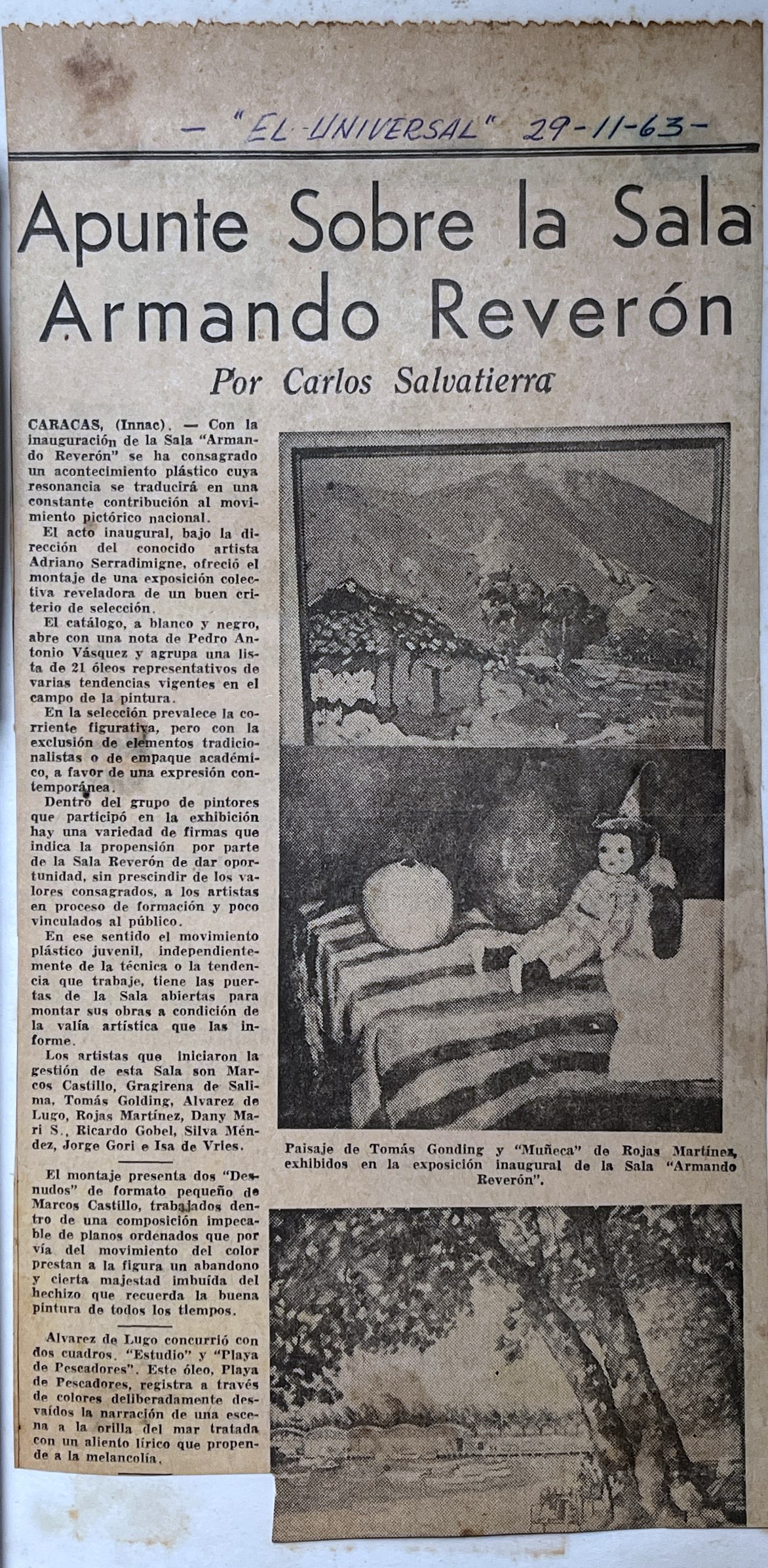
“EL UNIVERSAL” 29-11-63
Notes on the Armando Reverón Hall
By Carlos Salvatierra
CARACAS, (Innac). — With the inauguration of the “Armando Reverón” Hall, a plastic arts event has been established whose resonance will translate into a constant contribution to the national pictorial movement.
The inaugural act, under the direction of the well-known artist Adriano Serradimigni, featured the mounting of a collective exhibition revealing a high standard of selection. The catalog, in black and white, opens with a note by Pedro Antonio Vásquez and groups a list of 21 oil paintings representative of various current trends in the field of painting.
In the selection, the figurative trend prevails, but with the exclusion of traditionalist or academic elements in favor of a contemporary expression. Among the group of painters who participated in the exhibition, there is a variety of signatures indicating the Armando Reverón Hall’s propensity to provide opportunities—without disregarding established figures—to artists in the process of formation who are little known to the public.
In this sense, the youth art movement, regardless of the technique or trend they work in, has the doors of the Hall open to mount their works, provided that the artistic merit informs them. The artists who initiated the management of this Hall are: Marcos Castillo, Gragirena de Salima, Tomás Golding, Alvarez de Lugo, Rojas Martínez, Dany Mari S., Ricardo Gobel, Silva Méndez, Jorge Gori, and Isa de Vries.
The display features two “Nudes” in small format by Marcos Castillo, worked within an impeccable composition of ordered planes that, through the movement of color, lend an abandonment and a certain majesty to the figure, imbued with the spell that recalls the good painting of all times.
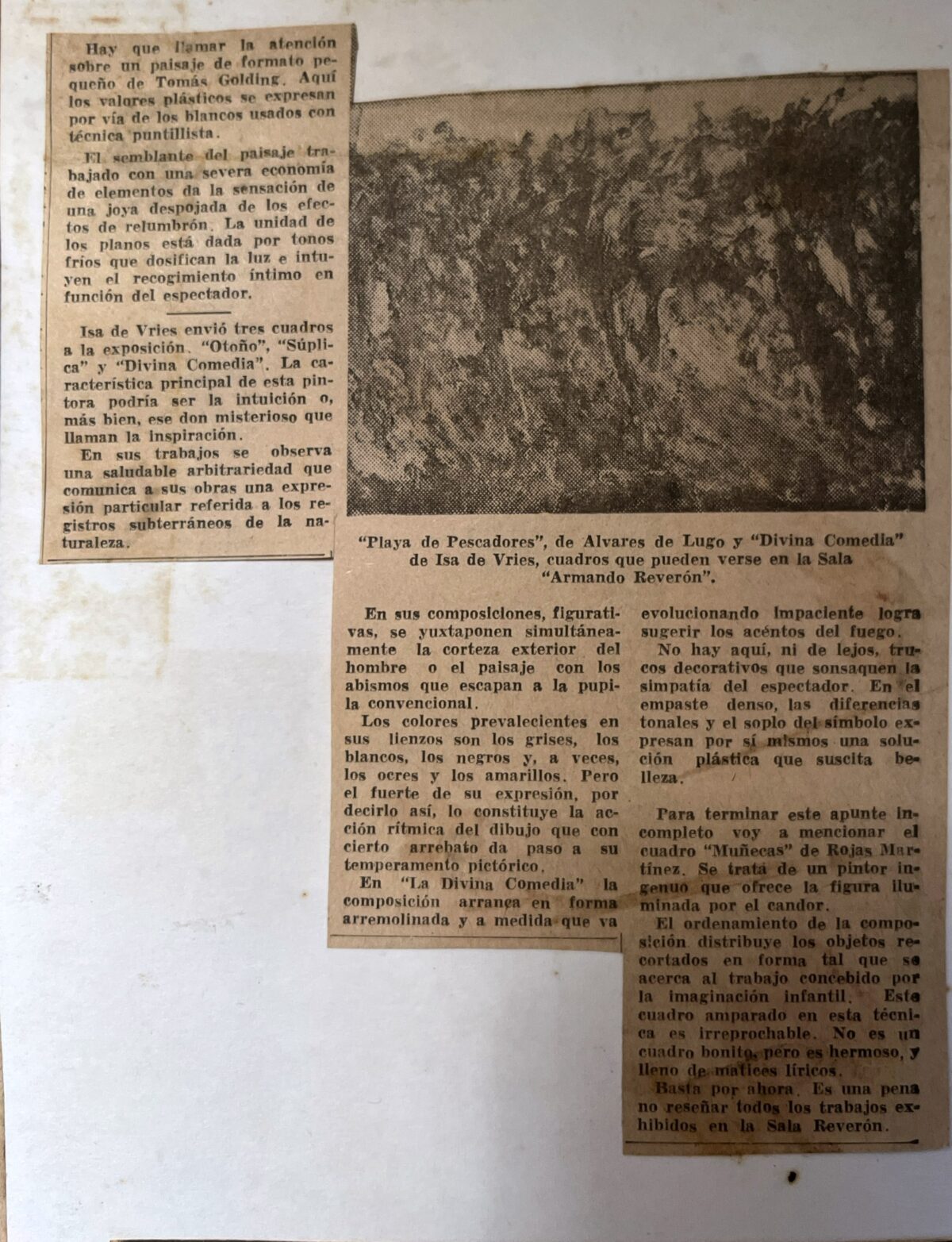
Alvarez de Lugo participated with two paintings: “Estudio” (Study) and “Playa de Pescadores” (Fishermen’s Beach). This oil painting, “Playa de Pescadores,” records through deliberately faded colors the narrative of a scene by the seashore, treated with a lyrical breath that tends toward melancholy.
Attention must be called to a small-format landscape by Tomás Golding. Here, the plastic values are expressed through the whites used with a pointillist technique. The appearance of the landscape, worked with a severe economy of elements, gives the feeling of a jewel stripped of dazzling effects. The unity of the planes is given by cold tones that dose the light and suggest intimate withdrawal for the viewer’s benefit.
Isa de Vries sent three paintings to the exhibition: “Otoño” (Autumn), “Súplica” (Plea), and “Divina Comedia” (Divine Comedy). The main characteristic of this painter could be intuition or, rather, that mysterious gift called inspiration. In her works, a healthy arbitrariness is observed that communicates to her pieces a particular expression referring to the subterranean registers of nature.
In her figurative compositions, the outer crust of man or the landscape is simultaneously juxtaposed with the abysses that escape the conventional eye. The prevailing colors in her canvases are grays, whites, blacks, and sometimes ochres and yellows. But the strength of her expression, so to speak, is constituted by the rhythmic action of the drawing which, with a certain outburst, gives way to her pictorial temperament.
In “Divina Comedia,” the composition starts in a swirling manner and, as it evolves impatiently, manages to suggest the accents of fire. There are no decorative tricks here that entice the viewer’s sympathy. In the dense impasto, the tonal differences and the breath of the symbol express a plastic solution in themselves that arouses beauty.
To finish these incomplete notes, I am going to mention the painting “Muñecas” (Dolls) by Rojas Martínez. This is a naive painter who offers a figure illuminated by candor. The arrangement of the composition distributes the objects, cut out in such a way that it approaches work conceived by a child’s imagination. This painting, supported by this technique, is irreproachable. It is not a “pretty” painting, but it is beautiful and full of lyrical nuances.
That is all for now. It is a pity not to review all the works exhibited in the Reverón Hall.
Transcripción Original (Español)
— “EL UNIVERSAL” 29-11-63 —
Apunte Sobre la Sala Armando Reverón
Por Carlos Salvatierra
CARACAS, (Innac). — Con la inauguración de la Sala “Armando Reverón” se ha consagrado un acontecimiento plástico cuya resonancia se traducirá en una constante contribución al movimiento pictórico nacional.
El acto inaugural, bajo la dirección del conocido artista Adriano Serradimigni, ofreció el montaje de una exposición colectiva reveladora de un buen criterio de selección. El catálogo, a blanco y negro, abre con una nota de Pedro Antonio Vásquez y agrupa una lista de 21 óleos representativos de varias tendencias vigentes en el campo de la pintura.
En la selección prevalece la corriente figurativa, pero con la exclusión de elementos tradicionalistas o de empaque académico, a favor de una expresión contemporánea. Dentro del grupo de pintores que participó en la exhibición hay una variedad de firmas que indica la propensión por parte de la Sala Reverón de dar oportunidad, sin prescindir de los valores consagrados, a los artistas en proceso de formación y poco vinculados al público.
En ese sentido el movimiento plástico juvenil, independientemente de la técnica o la tendencia que trabaje, tiene las puertas de la Sala abiertas para montar sus obras a condición de la valía artística que las informe. Los artistas que iniciaron la gestión de esta Sala son Marcos Castillo, Gragirena de Salima, Tomás Golding, Alvarez de Lugo, Rojas Martínez, Dany Mari S., Ricardo Gobel, Silva Méndez, Jorge Gori e Isa de Vries.
El montaje presenta dos “Desnudos” de formato pequeño de Marcos Castillo, trabajados dentro de una composición impecable de planos ordenados que por vía del movimiento del color prestan a la figura un abandono y cierta majestad imbuida del hechizo que recuerda la buena pintura de todos los tiempos.
Alvarez de Lugo concurrió con dos cuadros, “Estudio” y “Playa de Pescadores”. Este óleo, “Playa de Pescadores”, registra a través de colores deliberadamente desvaídos la narración de una escena a la orilla del mar tratada con un aliento lírico que propende a la melancolía.
Hay que llamar la atención sobre un paisaje de formato pequeño de Tomás Golding. Aquí los valores plásticos se expresan por vía de los blancos usados con técnica puntillista. El semblante del paisaje trabajado con una severa economía de elementos da la sensación de una joya despojada de los efectos de relumbrón. La unidad de los planos está dada por tonos fríos que dosifican la luz e intuyen el recogimiento íntimo en función del espectador.
Isa de Vries envió tres cuadros a la exposición, “Otoño”, “Súplica” y “Divina Comedia”. La característica principal de esta pintora podría ser la intuición o, más bien, ese don misterioso que llaman la inspiración. En sus trabajos se observa una saludable arbitrariedad que comunica a sus obras una expresión particular referida a los registros subterráneos de la naturaleza.
En sus composiciones, figurativas, se yuxtaponen simultáneamente la corteza exterior del hombre o el paisaje con los abismos que escapan a la pupila convencional. Los colores prevalecientes en sus lienzos son los grises, los blancos, los negros y, a veces, los ocres y los amarillos. Pero el fuerte de su expresión, por decirlo así, lo constituye la acción rítmica del dibujo que con cierto arrebato da paso a su temperamento pictórico.
En “La Divina Comedia” la composición arranca en forma arremolinada y a medida que va evolucionando impaciente logra sugerir los acentos del fuego. No hay aquí, ni de lejos, trucos decorativos que sonsaquen la simpatía del espectador. En el empaste denso, las diferencias tonales y el soplo del símbolo expresan por sí mismos una solución plástica que suscita belleza.
Para terminar este apunte incompleto voy a mencionar el cuadro “Muñecas” de Rojas Martínez. Se trata de un pintor ingenuo que ofrece la figura iluminada por el candor. El ordenamiento de la composición distribuye los objetos recortados en forma tal que se acerca al trabajo concebido por la imaginación infantil. Este cuadro amparado en esta técnica es irreproachable. No es un cuadro bonito, pero es hermoso, y lleno de matices líricos.
Basta por ahora. Es una pena no reseñar todos los trabajos exhibidos en la Sala Reverón.