English Translation
KENA MAGAZINE – NOV 2, 1972 No. 199
THE PLASTIC ARTS By BEATRIZ de LERBS
LIKE A LENS
“Oh, I wish I had ‘an Avila’!” This is a common expression among gallery-goers. The mountain has exerted an irresistible attraction since the days when the practitioners of the so-called School of Caracas—Luis Alfredo López Méndez, Pedro Angel González, Tomás Golding, and many others—felt captivated by its balanced masses and shifting tones. Their “Avilas” eventually became status symbols, as their prices began an ascent that threatens to reach the very peak of the mountain itself. Today, it is already traditional to include some view of the mountain in the exhibitions of our landscape artists. The public expects it.
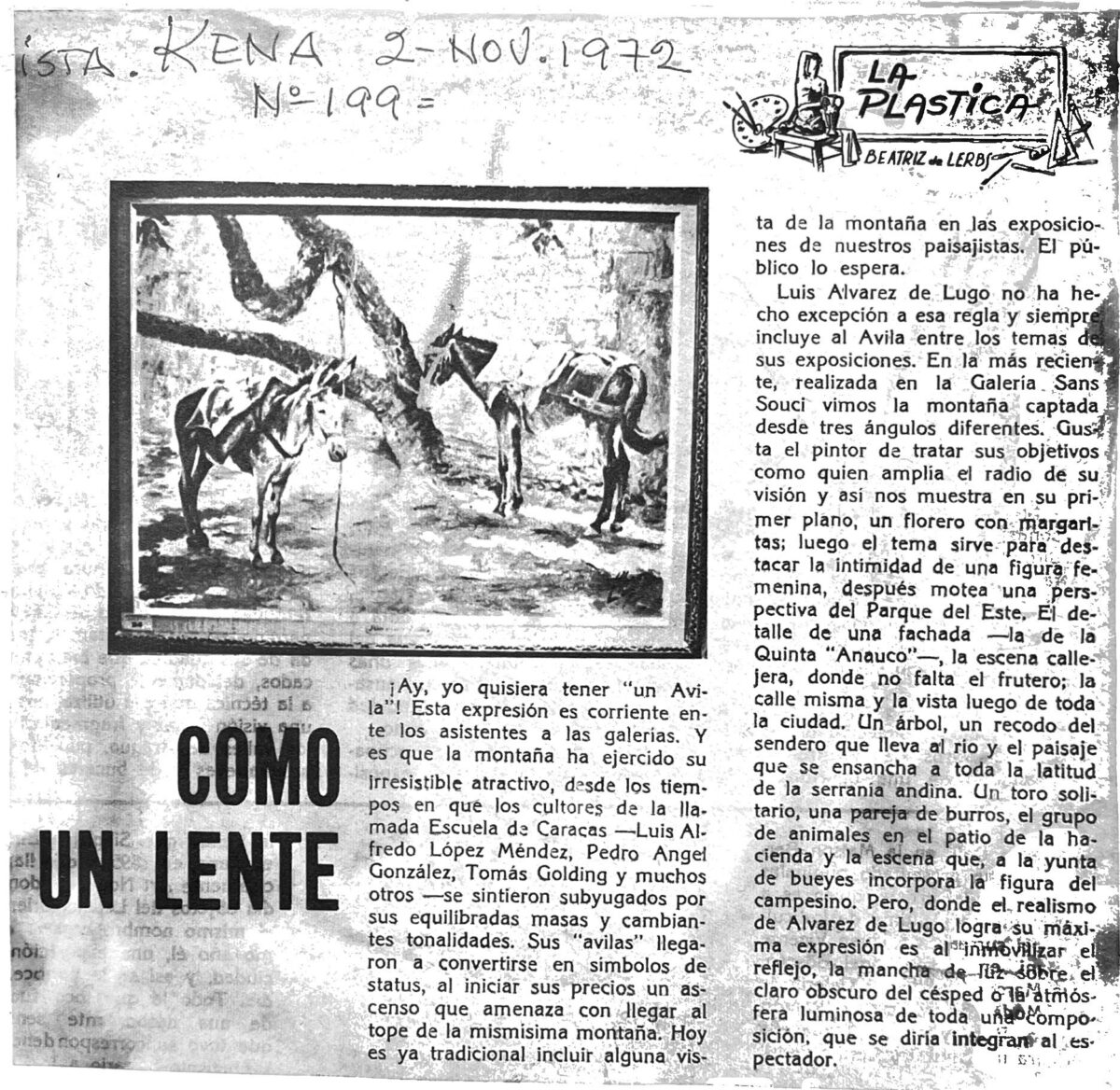
Luis Alvarez de Lugo is no exception to this rule and always includes the Avila among the subjects of his exhibitions. In the most recent one, held at the Sans Souci Gallery, we saw the mountain captured from three different angles. The painter likes to treat his subjects as one who widens the radius of their vision; thus, he shows us in his foreground a vase with daisies; then the theme serves to highlight the intimacy of a female figure; later, he flecks a perspective of Parque del Este, a detail of a facade—that of the “Anauco” Villa—a street scene where the fruit seller is not missing, the street itself, and then the view of the entire city. A tree, a bend in the path that leads to the river, and the landscape that widens to the full latitude of the Andean mountain range. A solitary bull, a pair of donkeys, a group of animals in the hacienda courtyard, and the scene that incorporates the figure of the peasant into the yoke of oxen. But where Alvarez de Lugo’s realism achieves its maximum expression is in immobilizing the reflection, the spot of light upon the chiaroscuro of the grass, or the luminous atmosphere of an entire composition, which one could say integrates the spectator.
Spanish Original (Transcripción Original)
REVISTA KENA 2-NOV. 1972 Nº 199
LA PLÁSTICA BEATRIZ de LERBS
COMO UN LENTE
“¡Ay, yo quisiera tener ‘un Avila’!” Esta expresión es corriente entre los asistentes a las galerías. Y es que la montaña ha ejercido su irresistible atractivo, desde los tiempos en que los cultores de la llamada Escuela de Caracas —Luis Alfredo López Méndez, Pedro Angel González, Tomás Golding y muchos otros— se sintieron subyugados por sus equilibradas masas y cambiantes tonalidades. Sus “avilas” llegaron a convertirse en símbolos de status, al iniciar sus precios un ascenso que amenaza con llegar al tope de la mismísima montaña. Hoy es ya tradicional incluir alguna vista de la montaña en las exposiciones de nuestros paisajistas. El público lo espera.
Luis Alvarez de Lugo no ha hecho excepción a esa regla y siempre incluye al Avila entre los temas de sus exposiciones. En la más reciente, realizada en la Galería Sans Souci vimos la montaña captada desde tres ángulos diferentes. Gusta el pintor de tratar sus objetivos como quien amplia el radio de su visión y así nos muestra en su primer plano, un florero con margaritas; luego el tema sirve para destacar la intimidad de una figura femenina, después motea una perspectiva del Parque del Este, El detalle de una fachada —la de la Quinta “Anauco”—, la escena callejera, donde no falta el frutero; la calle misma y la vista luego de toda la ciudad. Un árbol, un recodo del sendero que lleva al río y el paisaje que se ensancha a toda la latitud de la serranía andina. Un toro solitario, una pareja de burros, el grupo de animales en el patio de la hacienda y la escena que, a la yunta de bueyes incorpora la figura del campesino. Pero, donde el realismo de Alvarez de Lugo logra su máxima expresión es al inmovilizar el reflejo, la mancha de luz sobre el claro obscuro del césped o la atmósfera luminosa de toda una composición, que se diría integran al espectador.