English Translation
LA RELIGION – No. 24.108 – Caracas, Friday, May 8, 1970
Four Exhibitions: Venezuelan Painters at the “Salamandra”
By: CRUZ ECHENIQUE Photos: B. Pasaporte
Four exhibitions have piqued the public’s interest for several days, given the good selection of works and their quality.
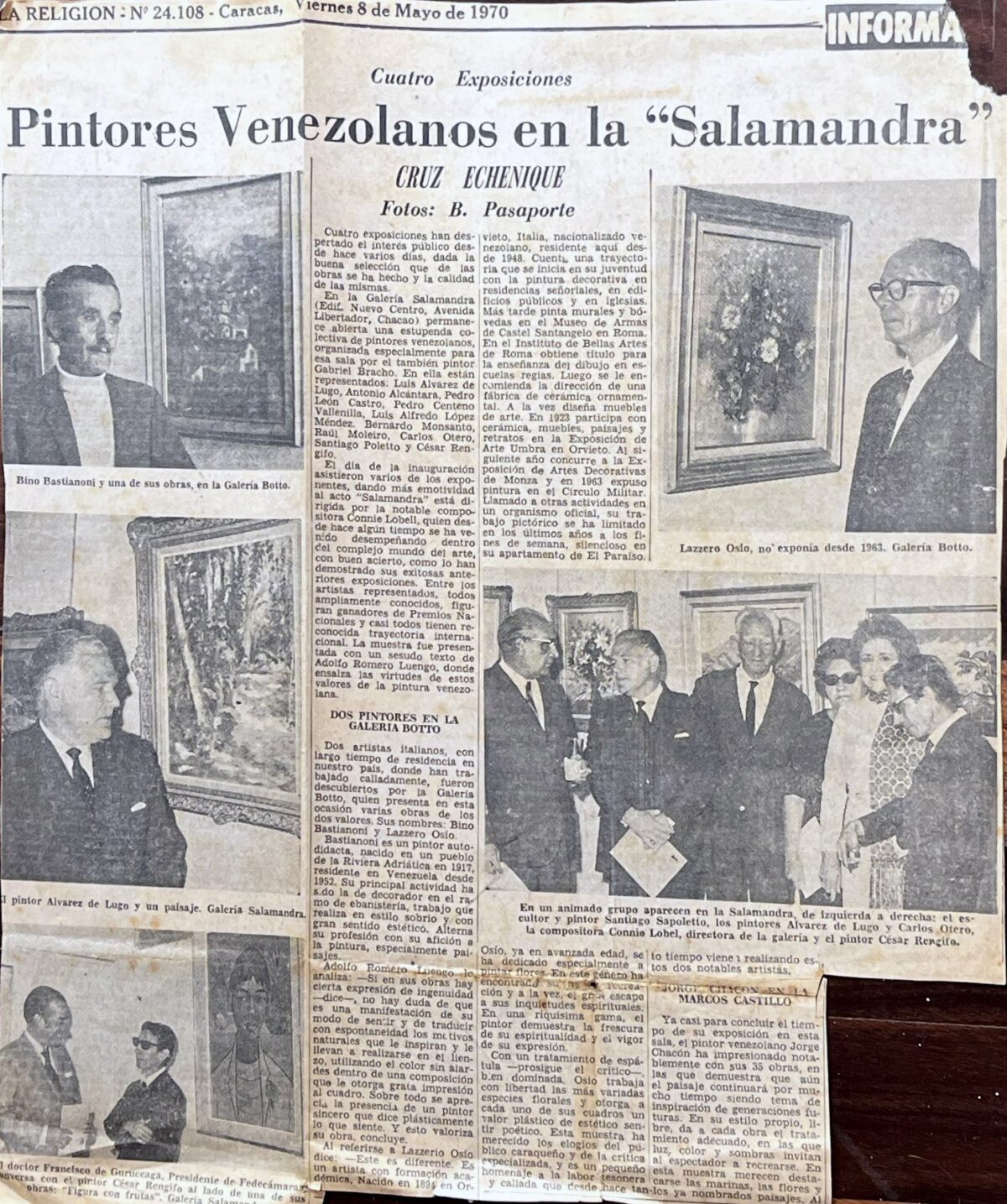
At the Galería Salamandra (Edif. Nuevo Centro, Avenida Libertador, Chacao), a wonderful collective exhibition of Venezuelan painters, specially organized for this room by painter Gabriel Bracho, remains open. Represented in it are: Luis Alvarez de Lugo, Antonio Alcántara, Pedro León Castro, Pedro Centeno Vallenilla, Luis Alfredo López Méndez, Bernardo Monsanto, Raúl Moleiro, Carlos Otero, Santiago Poletto, and César Rengifo.
On the day of the inauguration, various exhibitors attended, adding more emotion to the event. “Salamandra” is directed by the notable composer Connie Lobell, who for some time has been performing within the complex world of art with great success, as demonstrated by her successful previous exhibitions. Among the represented artists, all widely known, are National Prize winners with well-known national and international careers. The exhibition is presented with a thoughtful text by Adolfo Romero Luengo, where he extols the virtues of these figures of Venezuelan painting.
TWO PAINTERS AT THE GALERÍA BOTTO
Two Italian artists with a long residency in our country, where they have worked quietly, were discovered by the Galería Botto, which on this occasion presents several works by these two values. Their names: Bino Bastianoni and Lazzero Osio.
Bastianoni is a self-taught painter, born in a town on the Adriatic Riviera in 1917, a resident of Venezuela since 1952. His main activity has been as a decorator in the branch of cabinetmaking, work he performs with a sober style and great aesthetic sense. He alternates his profession with his passion for painting, especially landscapes.
Adolfo Romero Luengo analyzes: “If in his works there is a certain expression of ingenuity—he says—there is no doubt that it is a manifestation of his way of feeling and translating with spontaneity the natural motifs that inspire him and lead him to express himself on canvas, using color without fanfare within a composition that gives a pleasant impression to the painting. Above all, one appreciates the presence of a sincerity that he plastically says what he feels. And this validates his work,” he concludes.
When referring to Lazzero Osio, he says: “This is different. He is an artist with academic training. Born in 1894 in Orvieto, Italy, naturalized Venezuelan, resident here since 1948. He has a trajectory that began in his youth with decorative painting in noble residences, public buildings, and churches. Later he painted murals and vaults in the Museum of Arms of Castel Sant’Angelo in Rome. In the Institute of Fine Arts of Rome, he obtained his title for teaching ornamental ceramic drawing. At the same time, he designs art furniture. In 1923 he participated with ceramics, furniture, landscapes, and portraits in the Umbria Art Exhibition in Orvieto. The following year he attended the Decorative Arts Exhibition of Monza and in 1963 exhibited painting at the Círculo Militar. Called to other activities in an official body, his pictorial work has been limited in recent years to weekends, silent in his apartment in El Paraíso.
Osio, now at an advanced age, has dedicated himself especially to painting flowers. In this genre, he has found his recreation and, at the same time, the great escape for his spiritual concerns. In a very rich range, the painter demonstrates the freshness of his spirituality and the vigor of his expression.
With a palette knife treatment—continues the critic—in a dominated, free-spirited way, Osio works with freedom the most varied floral species and gives each of his paintings a high plastic value of poetic feeling. This exhibition has earned the praises of the Caracas public and specialized critics, and it is a small tribute to the persistent and quiet work that these two notable artists have been doing for so long.”
JORGE CHACON AT MARCOS CASTILLO
Almost to conclude the time of his exhibition in this room, the Venezuelan painter Jorge Chacón has notably impressed with his 35 works, in which he demonstrates that the landscape will continue for a long time being the theme of inspiration for generations of future artists. In his own style, filled with aesthetic sense, in which light, color, and shadows invite the viewer to recreate. In this exhibition, his seascapes, flowers, and the aforementioned landscapes deserve to be highlighted.
Original en Español
LA RELIGION – No. 24.108 – Caracas, viernes 8 de Mayo de 1970
Cuatro Exposiciones: Pintores Venezolanos en la “Salamandra”
Por: CRUZ ECHENIQUE Fotos: B. Pasaporte
Cuatro exposiciones han despertado el interés público desde hace varios días, dada la buena selección que de las obras se ha hecho y la calidad de las mismas.
En la Galería Salamandra (Edif. Nuevo Centro, Avenida Libertador, Chacao) permanece abierta una estupenda colectiva de pintores venezolanos, organizada especialmente para esa sala por el también pintor Gabriel Bracho. En ella están representados: Luis Alvarez de Lugo, Antonio Alcántara, Pedro León Castro, Pedro Centeno Vallenilla, Luis Alfredo López Méndez, Bernardo Monsanto, Raúl Moleiro, Carlos Otero, Santiago Poletto y César Rengifo.
El día de la inauguración asistieron varios de los exponentes, dando más emotividad al acto. “Salamandra” está dirigida por la notable compositora Connie Lobell, quien desde hace algún tiempo se ha venido desempeñando dentro del complejo mundo del arte, con buen acierto, como lo han demostrado sus exitosas anteriores exposiciones. Entre los artistas representados, todos ampliamente conocidos, figuran ganadores de Premios Nacionales y casi todos tienen reconocida trayectoria internacional. La muestra fue presentada con un sesudo texto de Adolfo Romero Luengo, donde ensalza las virtudes de estos valores de la pintura venezolana.
DOS PINTORES EN LA GALERIA BOTTO
Dos artistas italianos, con largo tiempo de residencia en nuestro país, donde han trabajado calladamente, fueron descubiertos por la Galería Botto, quien presenta en esta ocasión varias obras de estos dos valores. Sus nombres: Bino Bastianoni y Lazzero Osio.
Bastianoni es un pintor autodidacta, nacido en un pueblo de la Riviera Adriática en 1917, residente en Venezuela desde 1952. Su principal actividad ha sido la de decorador en el ramo de ebanistería, trabajo que realiza en estilo sobrio y con gran sentido estético. Alterna su profesión con su afición a la pintura, especialmente paisajes.
Adolfo Romero Luengo lo analiza: “Si en sus obras hay cierta expresión de ingenuidad —dice—, no hay duda de que es una manifestación de su modo de sentir y de traducir con espontaneidad los motivos naturales que le inspiran y le llevan a realizarse en el lienzo, utilizando el color sin alardes dentro de una composición que le otorga grata impresión al cuadro. Sobre todo se aprecia la presencia de una sinceridad de que dice plásticamente lo que siente. Y esto valoriza su obra”, concluye.
Al referirse a Lazzero Osio dice: “Este es diferente. Es un artista con formación académica. Nacido en 1894 en Orvieto, Italia, nacionalizado venezolano, residente aquí desde 1948. Cuenta una trayectoria que se inicia en su juventud con la pintura decorativa en residencias señoriales, en edificios públicos y en iglesias. Más tarde pinta murales y bóvedas en el Museo de Armas de Castel Sant’Angelo en Roma. En el Instituto de Bellas Artes de Roma obtiene título para la enseñanza del dibujo en escuelas regias. Luego se le encomienda la dirección de una fábrica de cerámica ornamental. A la vez diseña muebles de arte. En 1923 participa con cerámica, muebles, paisajes y retratos en la Exposición de Arte Umbra en Orvieto. Al siguiente año concurre a la Exposición de Artes Decorativas de Monza y en 1963 expuso pintura en el Círculo Militar. Llamado a otras actividades en un organismo oficial, su trabajo pictórico se ha limitado en los últimos años a los fines de semana, silencioso en su apartamento de El Paraíso.
Osio, ya en avanzada edad, se ha dedicado especialmente a pintar flores. En este género ha encontrado su recreación y a la vez el gran escape a sus inquietudes espirituales. En una riquísima gama, el pintor demuestra la frescura de su espiritualidad y el vigor de su expresión.
Con un tratamiento de espátula —prosigue el crítico—, en una dominada, Osio trabaja con libertad las más variadas especies florales y otorga a cada uno de sus cuadros un valor plástico de estético sentir poético. Esta muestra ha merecido los elogios del público caraqueño y de la crítica especializada, y es un pequeño homenaje a la labor tesonera y callada que desde hace tanto tiempo vienen realizando estos dos notables artistas.”
JORGE CHACON EN EL MARCOS CASTILLO
Ya casi para concluir el tiempo de su exposición en esta sala, el pintor venezolano Jorge Chacón ha impresionado notablemente con sus 35 obras, en las que demuestra que aún el paisaje continuará por mucho tiempo siendo tema de inspiración de generaciones futuras. En su estilo propio, lleno de sentido estético, en las que luz, color y sombras invitan al espectador a recrearse. En esta muestra merecen destacarse las marinas, las flores y los ya nombrados paisajes.