
English Transcription
EL UNIVERSAL, Monday, February 6, 1989
Brújula (Compass)
Excesses and Joys of Carnival
Guillermo José Schael
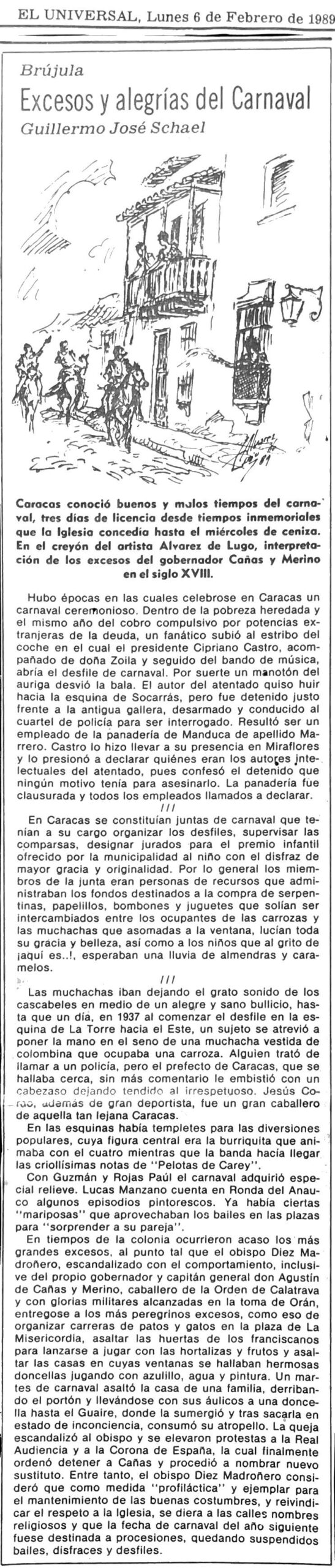
Caracas knew good and bad times of carnival, three days of license since immemorial times that the Church granted until Ash Wednesday. In the crayon [drawing] by artist Alvarez de Lugo, an interpretation of the excesses of Governor Cañas y Merino in the 18th century.
There were eras in which a ceremonious carnival was celebrated in Caracas. Amidst the inherited poverty and in the same year of the compulsive collection of debt by foreign powers, a fanatic jumped onto the step of the carriage in which President Cipriano Castro, accompanied by Doña Zoila and followed by the brass band, opened the carnival parade. Fortunately, a shove from the driver deflected the bullet. The perpetrator of the attack tried to flee toward the corner of Socarrás but was detained right in front of the old cockpit, disarmed, and taken to the police station to be interrogated. He turned out to be an employee of Manduca’s bakery named Marrero. Castro had him brought to his presence in Miraflores and pressured him to declare who the intellectual authors of the attack were, as the detainee confessed he had no motive to assassinate him. The bakery was closed, and all employees were called to testify.
In Caracas, carnival committees were formed that were in charge of organizing parades, supervising the comparsas, and appointing judges for the children’s prize offered by the municipality to the child with the most graceful and original costume. Generally, the members of the committee were wealthy individuals who administered the funds destined for the purchase of streamers, confetti, bonbons, and toys that were usually exchanged between the occupants of the floats and the girls who, peeking out of windows, displayed all their grace and beauty, as well as the children who, at the cry of “aquí es..!” (here it is!), waited for a rain of almonds and candies.
The girls left behind the pleasant sound of bells amidst a cheerful and healthy bustle, until one day in 1937, as the parade began at the corner of La Torre toward the East, a subject dared to put his hand on the breast of a young woman dressed as a colombina who occupied a float. Someone tried to call a policeman, but the prefect of Caracas, who was nearby, without further comment, charged him with a headbutt, leaving the disrespectful man sprawled out. Jesús Corrao, besides being a great athlete, was a great gentleman of that far-off Caracas.
In the corners, there were templetes (temporary stages) for popular entertainment, whose central figure was the burriquita who livened things up with the cuatro while the band played the very creole notes of “Pelotas de Carey.”
Under Guzmán and Rojas Paúl, the carnival acquired special prominence. Lucas Manzano recounts in Ronda del Anauco some picturesque episodes. There were already certain “butterflies” who took advantage of the dances in the squares to “surprise their partner.”
In colonial times, perhaps the greatest excesses occurred, to the point that Bishop Diez Madroñero, scandalized by the behavior—including that of the governor and captain general himself, Don Agustín de Cañas y Merino, Knight of the Order of Calatrava and with military glories achieved in the capture of Orán—surrendered to the most outlandish excesses. These included organizing duck and cat races in the Plaza de La Misericordia, raiding the orchards of the Franciscans to throw vegetables and fruits, and assaulting houses in whose windows beautiful maidens were playing with azulillo (blueing), water, and paint. One Carnival Tuesday, he assaulted a family’s house, knocking down the gate and, along with his courtiers, taking a maiden to the Guaire river, where he submerged her and, after taking her out in a state of unconsciousness, consumed his outrage. The complaint scandalized the bishop, and protests were raised to the Royal Audience and the Crown of Spain, which finally ordered the detention of Cañas and proceeded to appoint a new substitute. Meanwhile, Bishop Diez Madroñero considered that as a “prophylactic” measure and an example for the maintenance of good customs, and to reclaim respect for the Church, religious names should be given to the streets and that the carnival date of the following year should be destined for processions, leaving dances, costumes, and parades suspended.
Transcripción Original (Español)
EL UNIVERSAL, Lunes 6 de Febrero de 1989
Brújula
Excessos y alegrías del Carnaval
Guillermo José Schael
Caracas conoció buenos y malos tiempos del carnaval, tres días de licencia desde tiempos inmemoriales que la Iglesia concedía hasta el miércoles de ceniza. En el creyón del artista Alvarez de Lugo, interpretación de los excesos del gobernador Cañas y Merino en el siglo XVIII.
Hubo épocas en las cuales celebróse en Caracas un carnaval ceremonioso. Dentro de la pobreza heredada y el mismo año del cobro compulsivo por potencias extranjeras de la deuda, un fanático subió al estribo del coche en el cual el presidente Cipriano Castro, acompañado de doña Zoila y seguido del bando de música, abría el desfile de carnaval. Por suerte un manotón del auriga desvió la bala. El autor del atentado quiso huir hacia la esquina de Socarrás, pero fue detenido justo frente a la antigua gallera, desarmado y conducido al cuartel de policía para ser interrogado. Resultó ser un empleado de la panadería de Manduca de apellido Marrero. Castro lo hizo llevar a su presencia en Miraflores y lo presionó a declarar quiénes eran los autores intelectuales del atentado, pues confesó el detenido que ningún motivo tenía para asesinarlo. La panadería fue clausurada y todos los empleados llamados a declarar.
En Caracas se constituían juntas de carnaval que tenían a su cargo organizar los desfiles, supervisar las comparsas, designar jurados para el premio infantil ofrecido por la municipalidad al niño con el disfraz de mayor gracia y originalidad. Por lo general los miembros de la junta eran personas de recursos que administraban los fondos destinados a la compra de serpentinas, papelillos, bombones y juguetes que solían ser intercambiados entre los ocupantes de las carrozas y las muchachas que asomadas a la ventana, lucían toda su gracia y belleza, así como a los niños que al grito de ¡aquí es..!, esperaban una lluvia de almendras y caramelos.
Las muchachas iban dejando el grato sonido de los cascabeles en medio de un alegre y sano bullicio, hasta que un día, en 1937 al comenzar el desfile en la esquina de La Torre hacia el Este, un sujeto se atrevió a poner la mano en el seno de una muchacha vestida de colombina que ocupaba una carroza. Alguien trató de llamar a un policía, pero el prefecto de Caracas, que se hallaba cerca, sin más comentario le embistió con un cabezazo dejando tendido al irrespetuoso. Jesús Corrao, además de gran deportista, fue un gran caballero de aquella tan lejana Caracas.
En las esquinas había templetes para las diversiones populares, cuya figura central era la burriquita que animaba con el cuatro mientras que la banda hacía llegar las criollísimas notas de “Pelotas de Carey”.
Con Guzmán y Rojas Paúl el carnaval adquirió especial relieve. Lucas Manzano cuenta en Ronda del Anauco algunos episodios pintorescos. Ya había ciertas “mariposas” que aprovechaban los bailes en las plazas para “sorprender a su pareja”.
En tiempos de la colonia ocurrieron acaso los más grandes excesos, al punto tal que el obispo Diez Madroñero, escandalizado con el comportamiento, inclusive del propio gobernador y capitán general don Agustín de Cañas y Merino, caballero de la Orden de Calatrava y con glorias militares alcanzadas en la toma de Orán, entregóse a los más peregrinos excesos, como eso de organizar carreras de patos y gatos en la plaza de La Misericordia, asaltar las huertas de los franciscanos para lanzarse a jugar con las hortalizas y frutos y asaltar las casas en cuyas ventanas se hallaban hermosas doncellas jugando con azulillo, agua y pintura. Un martes de carnaval asaltó la casa de una familia, derribando el portón y llevándose con sus áulicos a una doncella hasta el Guaire, donde la sumergió y tras sacarla en estado de inconsciencia, consumó su atropello. La queja escandalizó al obispo y se elevaron protestas a la Real Audiencia y a la Corona de España, la cual finalmente ordenó detener a Cañas y procedió a nombrar nuevo sustituto. Entre tanto, el obispo Diez Madroñero consideró que como medida “profiláctica” y ejemplar para el mantenimiento de las buenas costumbres, y reivindicar el respeto a la Iglesia, se diera a las calles nombres religiosos y que la fecha de carnaval del año siguiente fuese destinada a procesiones, quedando suspendidos bailes, disfraces y desfiles.