English Translation
EL UNIVERSAL, Sunday, July 24, 1983
Brújula (Compass)
At 8 am, Bolívar is Born
Guillermo José Schael
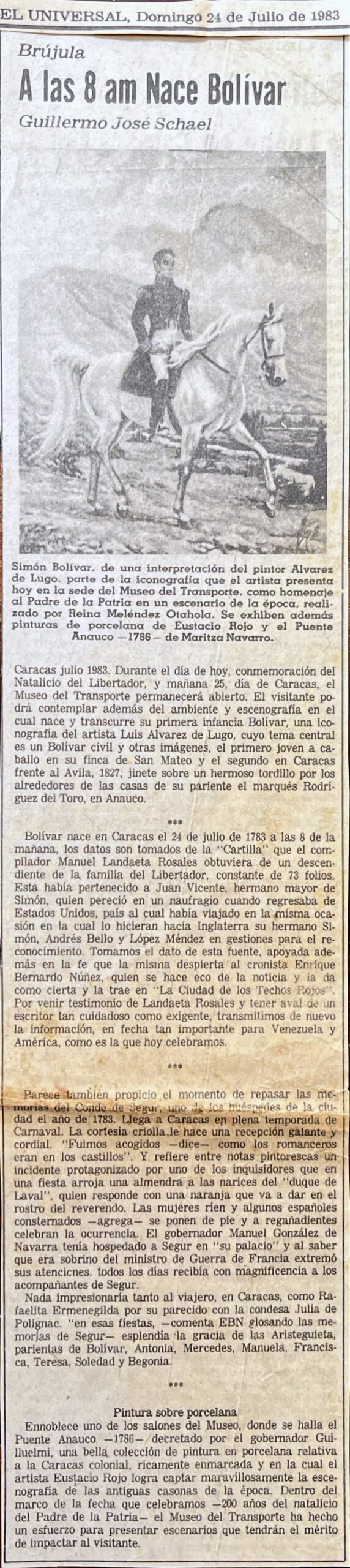
Simón Bolívar, from an interpretation by the painter Alvarez de Lugo, part of the iconography that the artist presents today at the headquarters of the Museum of Transport, as a tribute to the Father of the Fatherland in a setting of the era, created by Reina Meléndez Otahola. Porcelain paintings of Eustacio Rojo and the Anauco Bridge —1786— by Maritza Navarro are also on display.
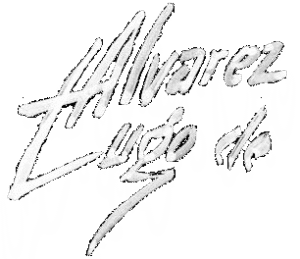
Caracas, July 1983. During the day today, commemorating the Birth of the Liberator, and tomorrow the 25th, the day of Caracas, the Museum of Transport will remain open. Visitors will also be able to contemplate the environment and scenery in which Bolívar’s early childhood was born and took place, an iconography by the artist Luis Alvarez de Lugo, whose central theme is a “civilian Bolívar” and other images; the first, a young man on horseback at his San Mateo estate, and the second in Caracas in front of the Avila, 1827, a rider on a beautiful dapple-grey horse around the houses of his relative, the Marquis Rodríguez del Toro, in Anauco.
Bolívar was born in Caracas on July 24, 1783, at 8 in the morning; the data is taken from the “Cartilla” (Primer) that the compiler Manuel Landaeta Rosales obtained from a descendant of the Liberator’s family, consisting of 73 folios. This had belonged to Juan Vicente, Simón’s elder brother, who perished in a shipwreck while returning from the United States, a country to which he had traveled on the same occasion that his brother Simón, Andrés Bello, and López Méndez had traveled to England on diplomatic missions. We take the data from this source, further supported by the faith it inspires in the chronicler Enrique Bernardo Núñez, who echoes the news and gives it as certain in “La Ciudad de los Techos Rojos” (The City of Red Roofs). Since it comes from the testimony of Landaeta Rosales and has the endorsement of a writer as careful as he is demanding, we transmit the information again, on a date as important for Venezuela and America as the one we celebrate today.
It also seems a propitious moment to review the memoirs of the Count of Segur, one of the travelers to the city in the year 1783. He arrived in Caracas in the middle of the Carnival season. Creole courtesy gave him a gallant and cordial reception. “We were welcomed,” he says, “like the troubadours were in the castles.” And he refers among picturesque notes to an incident involving one of the inquisitors who, at a party, threw an almond at the nose of the “Duke of Laval,” who responded with an orange that hit the reverend’s face. The women laughed and some Spaniards were dismayed—he adds—they stood up and reluctantly celebrated the occurrence. Governor Manuel González de Navarra had Segur hosted in “his palace” and upon learning that he was the nephew of the Minister of War of France, he intensified his attentions; every day he received Segur’s companions with magnificence.
Nothing would impress the traveler in Caracas as much as Rafaela Ermenegilda for her resemblance to Countess Julia de Polignac. “In those parties,” comments EBN [Enrique Bernardo Núñez] glossing Segur’s memoirs, “the grace of the Aristeguietas, relatives of Bolívar, shone: Antonia, Mercedes, Manuela, Francisca, Teresa, Soledad, and Begonia.”
Painting on Porcelain One of the museum halls is ennobled by the Anauco Bridge —1786— decreed by Governor Guillelmi, a beautiful collection of porcelain painting relating to colonial Caracas, richly framed and in which the artist Eustacio Rojo manages to marvelously capture the scenery of the old mansions of the era. Within the framework of the date we celebrate —200 years since the birth of the Father of the Country— the Museum of Transport has made an effort to present settings that will have the merit of impacting the visitor.
Texto Original en Español
EL UNIVERSAL, Domingo 24 de Julio de 1983
Brújula
A las 8 am Nace Bolívar
Guillermo José Schael
Simón Bolívar, de una interpretación del pintor Alvarez de Lugo, parte de la iconografía que el artista presenta hoy en la sede del Museo del Transporte, como homenaje al Padre de la Patria en un escenario de la época, realizado por Reina Meléndez Otahola. Se exhiben además pinturas de porcelana de Eustacio Rojo y el Puente Anauco —1786— de Maritza Navarro.
Caracas julio 1983. Durante el día de hoy, conmemoración del Natalicio del Libertador, y mañana 25, día de Caracas, el Museo del Transporte permanecerá abierto. El visitante podrá contemplar además del ambiente y escenografía en el cual nace y transcurre su primera infancia Bolívar, una iconografía del artista Luis Alvarez de Lugo, cuyo tema central es un Bolívar civil y otras imágenes, el primero joven a caballo en su finca de San Mateo y el segundo en Caracas frente al Avila, 1827, jinete sobre un hermoso tordillo por los alrededores de las casas de su pariente el marqués Rodríguez del Toro, en Anauco.
Bolívar nace en Caracas el 24 de julio de 1783 a las 8 de la mañana, los datos son tomados de la “Cartilla” que el compilador Manuel Landaeta Rosales obtuviera de un descendiente de la familia del Libertador, constante de 73 folios. Esta había pertenecido a Juan Vicente, hermano mayor de Simón, quien pereció en un naufragio cuando regresaba de Estados Unidos, país al cual había viajado en la misma ocasión en la cual lo hicieran hacia Inglaterra su hermano Simón, Andrés Bello y López Méndez en gestiones para el reconocimiento. Tomamos el dato de esta fuente, apoyada además en la fe que la misma despierta al cronista Enrique Bernardo Núñez, quien se hace eco de la noticia y la da como cierta y la trae en “La Ciudad de los Techos Rojos”. Por venir testimonio de Landaeta Rosales y tener aval de un escritor tan cuidadoso como exigente, transmitimos de nuevo la información, en fecha tan importante para Venezuela y América, como es la que hoy celebramos.
Parece también propicio el momento de repasar las memorias del Conde de Segur, uno de los viajeros de la ciudad el año de 1783. Llega a Caracas en plena temporada de Carnaval. La cortesía criolla le hace una recepción galante e cordial. “Fuimos acogidos —dice— como los romanceros eran en los castillos”. Y refiere entre notas pintorescas un incidente protagonizado por uno de los inquisidores que en una fiesta arroja una almendra a las narices del “duque de Laval”, quien responde con una naranja que va a dar en el rostro del reverendo. Las mujeres ríen y algunos españoles consternados —agrega— se ponen de pie y a regañadientes celebran la ocurrencia. El gobernador Manuel González de Navarra tenía hospedado a Segur en “su palacio” y al saber que era sobrino del ministro de Guerra de Francia extremó sus atenciones; todos los días recibía con magnificencia a los acompañantes de Segur.
Nada impresionaría tanto al viajero, en Caracas, como Rafaela Ermenegilda por su parecido con la condesa Julia de Polignac. “En esas fiestas, —comenta EBN glosando las memorias de Segur— esplendía la gracia de las Aristeguieta, parientas de Bolívar, Antonia, Mercedes, Manuela, Francisca, Teresa, Soledad y Begonia.
Pintura sobre porcelana Ennoblece uno de los salones del Museo, donde se halla el Puente Anauco —1786— decretado por el gobernador Guillelmi, una bella colección de pintura en porcelana relativa a la Caracas colonial, ricamente enmarcada y en la cual el artista Eustacio Rojo logra captar maravillosamente la escenografía de las antiguas casonas de la época. Dentro del marco de la fecha que celebramos —200 años del natalicio del Padre de la Patria— el Museo del Transporte ha hecho un esfuerzo para presentar escenarios que tendrán el mérito de impactar al visitante.