English Translation
MUSEUM ROUNDUP
Venezuelan Masters of Landscape and the Nude Stand Out in Abundant and Select Caracas Exhibition
LOPEZ MENDEZ AND ALVAREZ DE LUGO REAFFIRM THEIR VOCATION FOR BEAUTY
- The paintings of Luis Alfredo say they come from Margarita, just as a few years ago they reflected his ecstatic contemplation of the Temple of Olympia or the Parthenon in Athens…
- In Eduardo Sosa Rodríguez, grays dominate, as if defying the tropical influence.
- The youths present in the themes of Sobieski.
By Euro Fuenmayor / PHOTOS: Dimas Ibarra
Master Luis Alfredo López Méndez carries his transparent humor among fans and art lovers, indifferent, perhaps complacent, in a way that falls over his shoulder. “Master, your jacket is stained…” “Ah, yes… it was this morning, a church candle fell on me…” We suppose he was at Mass early and a candle dripped wax on him. He continues through the hall, restless. They seek him out, they hug him. He goes to meet them, also looking, smiling. Like some time ago, he cannot stop even in the hall. His paintings say they come from Margarita. Just as a few years ago they reflected his ecstatic contemplation of the Temple of Olympia or the Parthenon in Athens; and as decades ago they brought the eternal gray of Paris and the blackened walls of the Seine.
The Sans Souci Gallery presents him in a group show with Tomás Golding, Luis Alvarez de Lugo, Fidel Santamaría, Francisco Vadillo, Eduardo Sosa Rodríguez, and Rafael Polanco.
MASTER OF SYNTHESIS Marine, Avila, Landscape, View of Caracas, Vista del Avila, Quema, Flowers, Landscape… In Tomás Golding, the tones sharpen like a tuning fork for his painting. Golding reaches an incredible simplicity that only highlights his cleanliness, both products of a refined technique enriched by years of work and research.
THE ELONGATED AESTHETIC Alvarez de Lugo has been painting for 30 years, but only for 12 has he lived solely from painting. Before, his profession, his livelihood, was as a draftsman-calculator for oil companies or the Ministry of Mines, and also as an advertising draftsman. He studied with Durban in the old school of plastic arts on the corner of El Cuño, and although he has painted and sold many paintings, he considers that his pace of production is unhurried and free of commercial pressures.
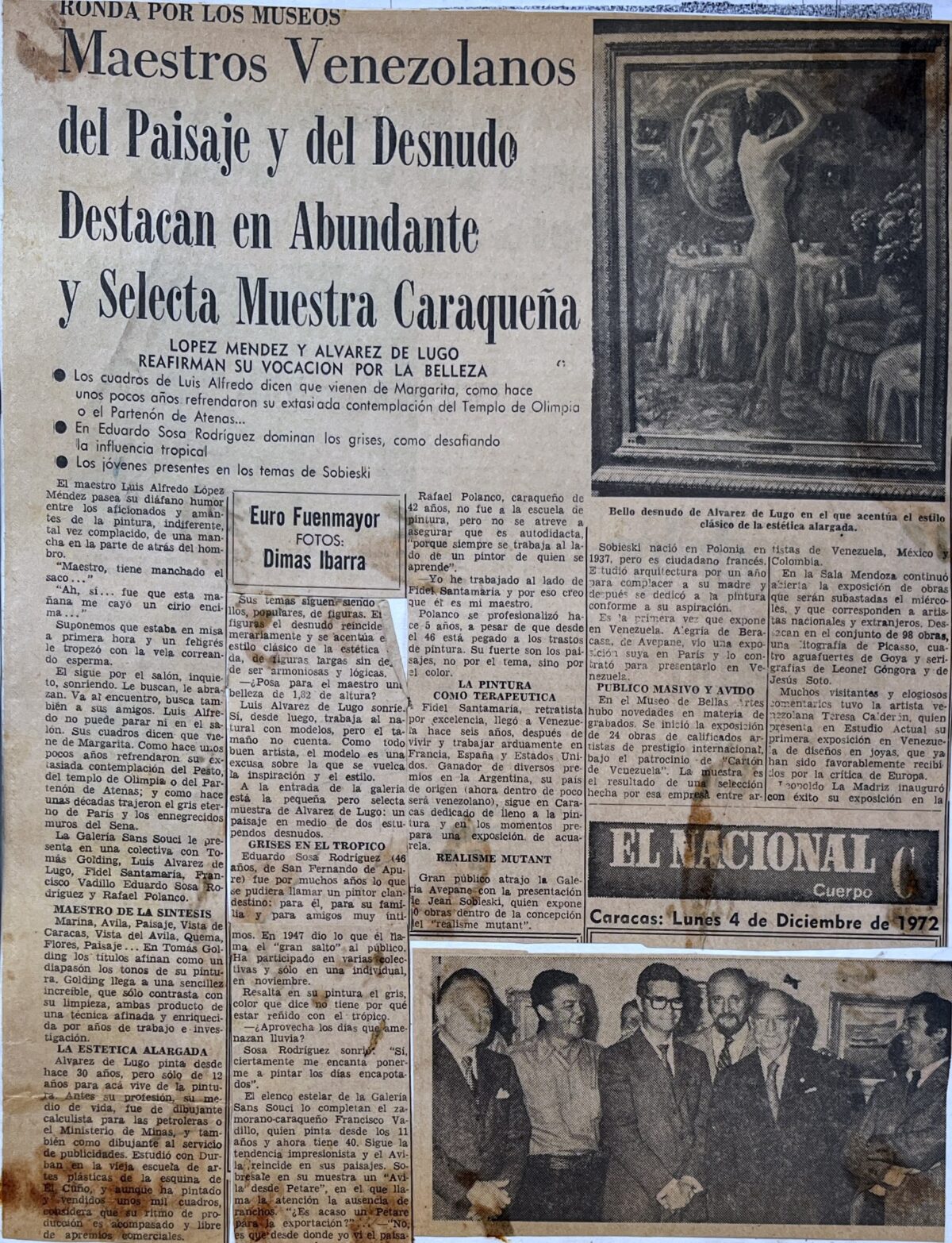
His themes remain simple, popular, of figures. The nude stands out, reaffirming and accentuating the classic style of elongated aesthetics, of long figures without losing harmony and logic. “Does the master pose for a 1.82-meter beauty?” Luis Alvarez de Lugo smiles. Yes, of course, he works from nature with models, but size doesn’t matter. As every good artist, the model is an excuse so that the inspiration and style can take flight.
At the entrance of the Origen gallery (now within the selection of the prestigious international “Cartón de Venezuela” award), there is a small but select exhibition by Alvarez de Lugo: a case dedicated fully to landscape amidst two stupendous nudes.
GRAYS IN THE TROPICS Eduardo Sosa Rodríguez (46 years old, from San Fernando de Apure) was for many years what could be called a clandestine painter: for him, for his family, and for very close friends. In 1947 he gave what he calls the “big jump” to the public. He has participated in several group shows and only one solo show, in November. His painting stands out for the gray color that he says has no reason to be at odds with the tropics. “Do you take advantage of the days that threaten rain?” Sosa Rodríguez smiles: “Yes, I certainly love to go out and paint on overcast days.”
The star cast of the Sans Souci Gallery is completed by the Zamoran-Caracan Francisco Vadillo, who has been painting since he was 11 and is now 40. He follows the impressionist trend, and the Avila region recurs in his landscapes. In his exhibition, he highlights an “Avila from Petare,” in which the absence of shacks [ranchos] is striking. “Is it perhaps a Petare for export?…” “No, it’s that from where I saw it, the landscape was beautiful…”
Rafael Polanco, a 42-year-old Caracan, was not at the school of painting, but he does not dare to call himself self-taught “because one always works at the side of a painter from whom one learns.” “I have worked alongside Fidel Santamaría and that’s why I believe he is my master.” Polanco went professional 5 years ago, despite the fact that for 46 years he has been attached to the painting tools. His strength is landscapes, not for the theme, but for the color.
PAINTING AS THERAPY Fidel Santamaría, portraitist par excellence, arrived in Venezuela six years ago, after having lived and worked hard in France, Spain, and the United States. Winner of various awards in Argentina, his country (now within a short time he will be Venezuelan), he remains in Caracas dedicated fully to painting and, in moments of rest, to watercolors.
MUTANT REALISM A large audience attracted the Galerie Avepane with the presentation of Jean Sobieski, who exhibits 30 works within the concept of “mutant realism.” Sobieski was born in Poland, but is a French citizen. He studied architecture for one year in 1937, but then dedicated himself to painting according to his aspiration. It is the first time he has exhibited in Venezuela. Alegría de Beracasa, of Avepane, saw an exhibition of his in Paris and contacted him to present him in Venezuela.
MASSIVE AND EAGER PUBLIC In the Museum of Fine Arts, there were new developments in engravings. The exhibition of 24 works by qualified artists of international prestige began, under the sponsorship of “Cartón de Venezuela.” The exhibition is the result of a selection made by that company among artists from Venezuela, Mexico, and Colombia. In the Sala Mendoza, the exhibition of works that will be auctioned on Wednesday continues, corresponding to national and foreign artists. Highlights in the set of 98 works include a lithograph by Picasso, four etchings by Goya and serigraphs by Leonel Góngora and Jesús Soto. Many visitors and complimentary comments were received by artist Teresa Calderón, who presents at Estudio Actual her first exhibition in Venezuela, of jewelry designs, which have been favorably received by European critics. Leopoldo La Madriz successfully inaugurated his exhibition in the city.
Original en Español
RONDA POR LOS MUSEOS
Maestros Venezolanos del Paisaje y del Desnudo Destacan en Abundante y Selecta Muestra Caraqueña
LOPEZ MENDEZ Y ALVAREZ DE LUGO REAFIRMAN SU VOCACION POR LA BELLEZA
- Los cuadros de Luis Alfredo dicen que vienen de Margarita, como hace unos pocos años refrendaron su extasiada contemplación del Templo de Olimpia o el Partenón de Atenas…
- En Eduardo Sosa Rodríguez dominan los grises, como desafiando la influencia tropical.
- Los jóvenes presentes en los temas de Sobieski.
Por Euro Fuenmayor / FOTOS: Dimas Ibarra
El maestro Luis Alfredo López Méndez pasea su diáfano humor entre los aficionados y amantes de la pintura, indiferente, tal vez complacido, de una mancha en la parte de atrás del hombro. “Maestro, tiene manchado el saco…” “Ah, sí… fue que esta mañana me cayó un cirio encima…” Suponemos que estaba en misa a primera hora y un faldón le tropezó con la vela chorreando esperma. Él sigue por el salón, inquieto. Le buscan, le abrazan. Va al encuentro, busca también a sus amigos. Luis Alfredo no puede parar ni en el salón. Sus cuadros dicen que viene de Margarita. Como hace unos pocos años refrendaron su extasiada contemplación del Templo de Olimpia o del Partenón de Atenas; y como hace unas décadas trajeron el gris eterno de París y los ennegrecidos muros del Sena.
La Galería Sans Souci le presenta en una colectiva con Tomás Golding, Luis Alvarez de Lugo, Fidel Santamaría, Francisco Vadillo, Eduardo Sosa Rodríguez y Rafael Polanco.
MAESTRO DE LA SINTESIS Marina, Avila, Paisaje, Vista de Caracas, Vista del Avila, Quema, Flores, Paisaje… En Tomás Golding los títulos afinan como un diapasón los tonos de su pintura. Golding llega a una sencillez increíble, que sólo contrasta con su limpieza, ambas producto de una técnica afinada y enriquecida por años de trabajo e investigación.
LA ESTETICA ALARGADA Alvarez de Lugo pinta desde hace 30 años, pero sólo de 12 años para acá vive de la pintura. Antes su profesión, su medio de vida, fue de dibujante calculista para las petroleras o el Ministerio de Minas, y también como dibujante al servicio de publicidades. Estudió con Durban en la vieja escuela de artes plásticas de la esquina de El Cuño, y aunque ha pintado y vendido muchos cuadros, considera que su ritmo de producción es acompasado y libre de apremios comerciales.
Sus temas siguen siendo sencillos, populares, de figuras. El desnudo reincide y se acentúa el estilo clásico de la estética alargada, de figuras largas sin de ser armoniosas y lógicas. “¿Posa para el maestro una belleza de 1,82 de altura?” Luis Alvarez de Lugo sonríe. Sí, desde luego, trabaja al natural con modelos, pero el tamaño no cuenta. Como todo buen artista, el modelo es una excusa sobre la que se vuelca la inspiración y el estilo.
A la entrada de la galería Origen (ahora dentro de la selección del prestigioso premio internacional de “Cartón de Venezuela”), sigue una pequeña pero selecta muestra de Alvarez de Lugo: un caso dedicado de lleno al paisaje en medio de dos estupendos desnudos.
GRISES EN EL TROPICO Eduardo Sosa Rodríguez (46 años, de San Fernando de Apure) fue por muchos años lo que se pudiera llamar un pintor clandestino: para él, para su familia y para amigos muy íntimos. En 1947 dio lo que él llama el “gran salto” al público. Ha participado en varias colectivas y sólo en una individual, en noviembre. Resalta en su pintura el gris, color que dice no tiene por qué estar reñido con el trópico. “¿Aprovecha los días que amenazan lluvia?” Sosa Rodríguez sonríe: “Sí, ciertamente me encanta ponerme a pintar los días encapotados”.
El elenco estelar de la Galería Sans Souci lo completan el zamorano-caraqueño Francisco Vadillo, quien pinta desde los 11 años y ahora tiene 40. Sigue la tendencia impresionista y el Avila reincide en sus paisajes. Sobresale en su muestra un “Avila desde Petare”, en el que llama la atención la ausencia de ranchos. “¿Es acaso un Petare para la exportación?…” “No, es que desde donde yo vi el paisaje era bello…”
Rafael Polanco, caraqueño de 42 años, no fue a la escuela de pintura, pero no se atreve a asegurar que es autodidacta “porque siempre se trabaja al lado de un pintor de quien se aprende”. “Yo he trabajado al lado de Fidel Santamaría y por eso creo que él es mi maestro”. Polanco se profesionalizó hace 5 años, a pesar de que desde el 46 está pegado a los trastos de pintura. Su fuerte son los paisajes, no por el tema, sino por el color.
LA PINTURA COMO TERAPEUTICA Fidel Santamaría, retratista por excelencia, llegó a Venezuela hace seis años, después de vivir y trabajar arduamente en Francia, España y Estados Unidos. Ganador de diversos premios en la Argentina, su país (ahora dentro de poco será venezolano), sigue en Caracas dedicado de lleno a la pintura y en los momentos de descanso, de acuarela.
REALISME MUTANT Gran público atrajo la Galerie Avepane con la presentación de Jean Sobieski, quien expone 30 obras dentro de la concepción del “realisme mutant”. Sobieski nació en Polonia, pero es ciudadano francés. Estudió arquitectura por un año en 1937, pero luego se dedicó a la pintura conforme a su aspiración. Es la primera vez que expone en Venezuela. Alegría de Beracasa, de Avepane, vio una exposición suya en París y lo contrató para presentarlo en Venezuela.
PUBLICO MASIVO Y AVIDO En el Museo de Bellas Artes hubo novedades en materia de grabados. Se inició la exposición de 24 obras de calificados artistas de prestigio internacional, bajo el patrocinio de “Cartón de Venezuela”. La muestra es el resultado de una selección hecha por esa empresa entre artistas de Venezuela, México y Colombia. En la Sala Mendoza continuó la exposición de obras que serán subastadas el miércoles, y que corresponden a artistas nacionales y extranjeros. Destacan en el conjunto de 98 obras, una litografía de Picasso, cuatro aguafuertes de Goya y serigrafías de Leonel Góngora y de Jesús Soto. Muchos visitantes y elogiosos comentarios tuvo la artista Teresa Calderón, quien presenta en Estudio Actual su primera exposición en Venezuela, de diseños en joyas, que han sido favorablemente recibidos por la crítica de Europa. Leopoldo La Madriz inauguró con éxito su exposición en la ciudad.