
English Translation
CULTURAL MERIDIAN
The Old and the New In the Painting of L. Alvarez de Lugo
Throughout tomorrow and into the evening, the artist Luis Alvarez de Lugo will inaugurate a new exhibition of his paintings, the result of nearly two years of work. His last exhibition, held on December 11, 1966, focused on the theme of Colonial Caracas. For that, he drew inspiration from the city’s quadricentennial anniversary as well as the release of the book “Caracas from Century to Century” by our collaborator Guillermo José Schael, for which Alvarez de Lugo conceived interesting prints with a nostalgic colonial flavor. Similarly, a painting by the artist titled “Old Print” (marked as No. 34 in this exhibition) will illustrate the cover of Schael’s upcoming book, which will soon enter circulation. In it, the author captures a sequence of life in Caracas during years past under the title “The City That Does Not Return,” containing—in addition to picturesque reminiscences written in his peculiar style—more than two hundred full-color reproductions of old postcards.
Alvarez de Lugo began his studies in painting under the direction of the recently deceased master Martín Durbán, a native of Zaragoza and countryman of Francisco de Goya y Lucientes. It was Durbán who instructed him in the portrait technique in which he has excelled. His study of “The Liberator” (Simón Bolívar) has been widely celebrated, executed with an appreciable mastery of drawing and a capturing of the defining traits of the hero’s character, as has his portrait of the well-known and fondly remembered antiquarian Raúl Santana. In Alvarez de Lugo’s work, drawing and color work in parallel. With long, fine brushstrokes—and in many cases with the aid of a palette knife—he combines pigments to achieve a harmonious coloring, pleasing to the eye. He prefers shifts in yellow and red ranges. He never uses black, applying sienna instead to achieve cheerful and optimistic effects. Figurative in style, he adopts many techniques devised by the Impressionists, giving his canvases an original language that is nonetheless not devoid of traditional values. The painter finds inspiration in a wide variety of local themes. Some of his paintings update contemporary female fashion, such as “Ruth” or “Reading,” in which he exalts the dynamism and beauty of the modern woman. His presenter, Santiago Magariños, refers specifically to the balance established by Alvarez de Lugo in conceiving a work adapted to the present time but one that delves into the sources of the past to extract from it the breath of the eternal, stating: “In these paintings, Luis Alvarez de Lugo employs a realistic language through landscapes, his ‘Flowers,’ and ‘Portraits,’ brightening them with the splendid blooming of light and color in the manner of Tito Salas’s brush, or those of the old Spanish school of Zuloaga, López Mezquita, and Alvarez de Sotomayor, famous in their time. But as a man of his time, Alvarez de Lugo ‘modernizes’ that style by making use of the experiences gathered from new artistic movements.” There are thirty-five canvases of the most diverse subject matter, in which it is easy to appreciate the painter’s evolution toward greater freedom and fluidity in both drawing and the constructivism of the painting.
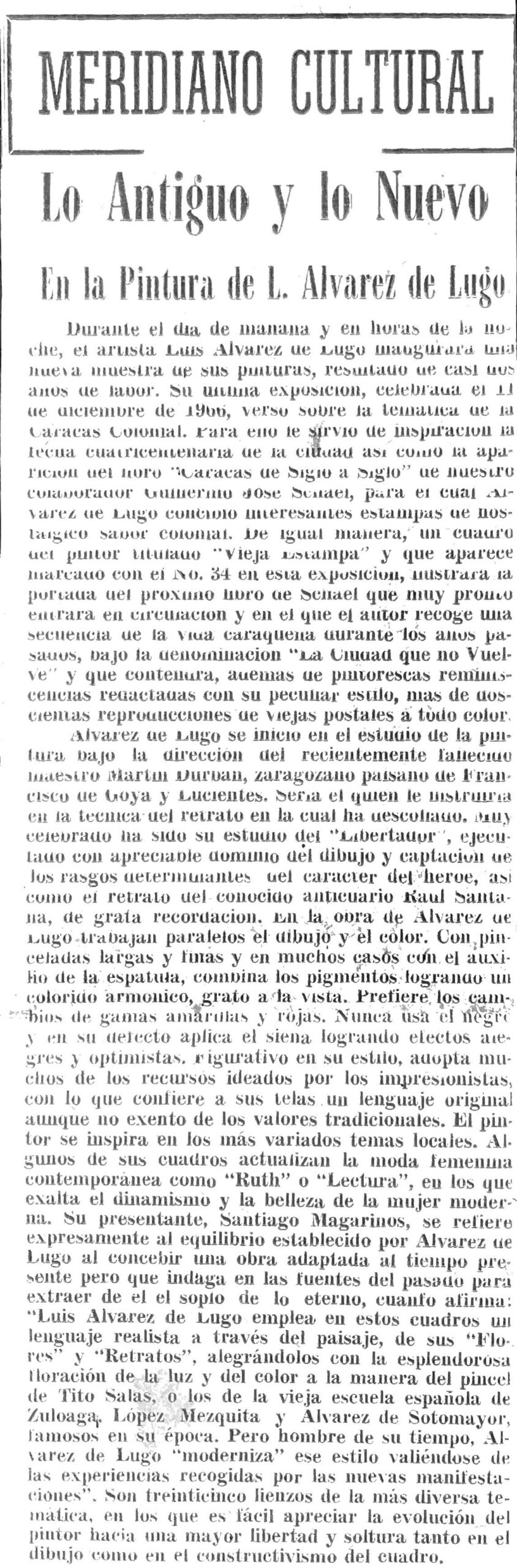
Original en Español
MERIDIANO CULTURAL
Lo Antiguo y lo Nuevo En la Pintura de L. Alvarez de Lugo
Durante el día de mañana y en horas de la noche, el artista Luis Alvarez de Lugo inaugurará una nueva muestra de sus pinturas, resultado de casi dos años de labor. Su última exposición, celebrada el 11 de diciembre de 1966, versó sobre la temática de la Caracas Colonial. Para ello le sirvió de inspiración la fecha cuatricentenaria de la ciudad así como la aparición del libro “Caracas de Siglo a Siglo” de nuestro colaborador Guillermo José Schael, para el cual Alvarez de Lugo concibió interesantes estampas de nostálgico sabor colonial. De igual manera, un cuadro del pintor titulado “Vieja Estampa” y que aparece marcado con el No. 34 en esta exposición, ilustrará la portada del próximo libro de Schael que muy pronto entrará en circulación y en el que el autor recoge una secuencia de la vida caraqueña durante los años pasados, bajo la denominación “La Ciudad que no Vuelve” y que contendrá, además de pintorescas reminiscencias redactadas con su peculiar estilo, más de doscientas reproducciones de viejas postales a todo color.
Alvarez de Lugo se inició en el estudio de la pintura bajo la dirección del recientemente fallecido maestro Martín Durbán, zaragozano paisano de Francisco de Goya y Lucientes. Sería él quien le instruiría en la técnica del retrato en la cual ha descollado. Muy celebrado ha sido su estudio del “Libertador”, ejecutado con apreciable dominio del dibujo y captación de los rasgos determinantes del carácter del héroe, así como el retrato del conocido anticuario Raúl Santana, de grata recordación. En la obra de Alvarez de Lugo trabajan paralelos el dibujo y el color. Con pinceladas largas y finas y en muchos casos con el auxilio de la espátula, combina los pigmentos logrando un colorido armónico, grato a la vista. Prefiere los cambios de gamas amarillas y rojas. Nunca usa el negro y en su defecto aplica el siena logrando efectos alegres y optimistas. Figurativo en su estilo, adopta muchos de los recursos ideados por los impresionistas, con lo que confiere a sus telas un lenguaje original aunque no exento de los valores tradicionales. El pintor se inspira en los más variados temas locales. Algunos de sus cuadros actualizan la moda femenina contemporánea como “Ruth” o “Lectura”, en los que exalta el dinamismo y la belleza de la mujer moderna. Su presentante, Santiago Magariños, se refiere expresamente al equilibrio establecido por Alvarez de Lugo al concebir una obra adaptada al tiempo presente pero que indaga en las fuentes del pasado para extraer de él el soplo de lo eterno, cuando afirma: “Luis Alvarez de Lugo emplea en estos cuadros un lenguaje realista a través del paisaje, de sus ‘Flores’ y ‘Retratos’, alegrándolos con la esplendorosa floración de la luz y del color a la manera del pincel de Tito Salas, o los de la vieja escuela española de Zuloaga, López Mezquita y Alvarez de Sotomayor, famosos en su época. Pero hombre de su tiempo, Alvarez de Lugo ‘moderniza’ ese estilo valiéndose de las experiencias recogidas por las nuevas manifestaciones”. Son treinticinco lienzos de la más diversa temática, en los que es fácil apreciar la evolución del pintor hacia una mayor libertad y soltura tanto en el dibujo como en el constructivismo del cuadro.