English Translation
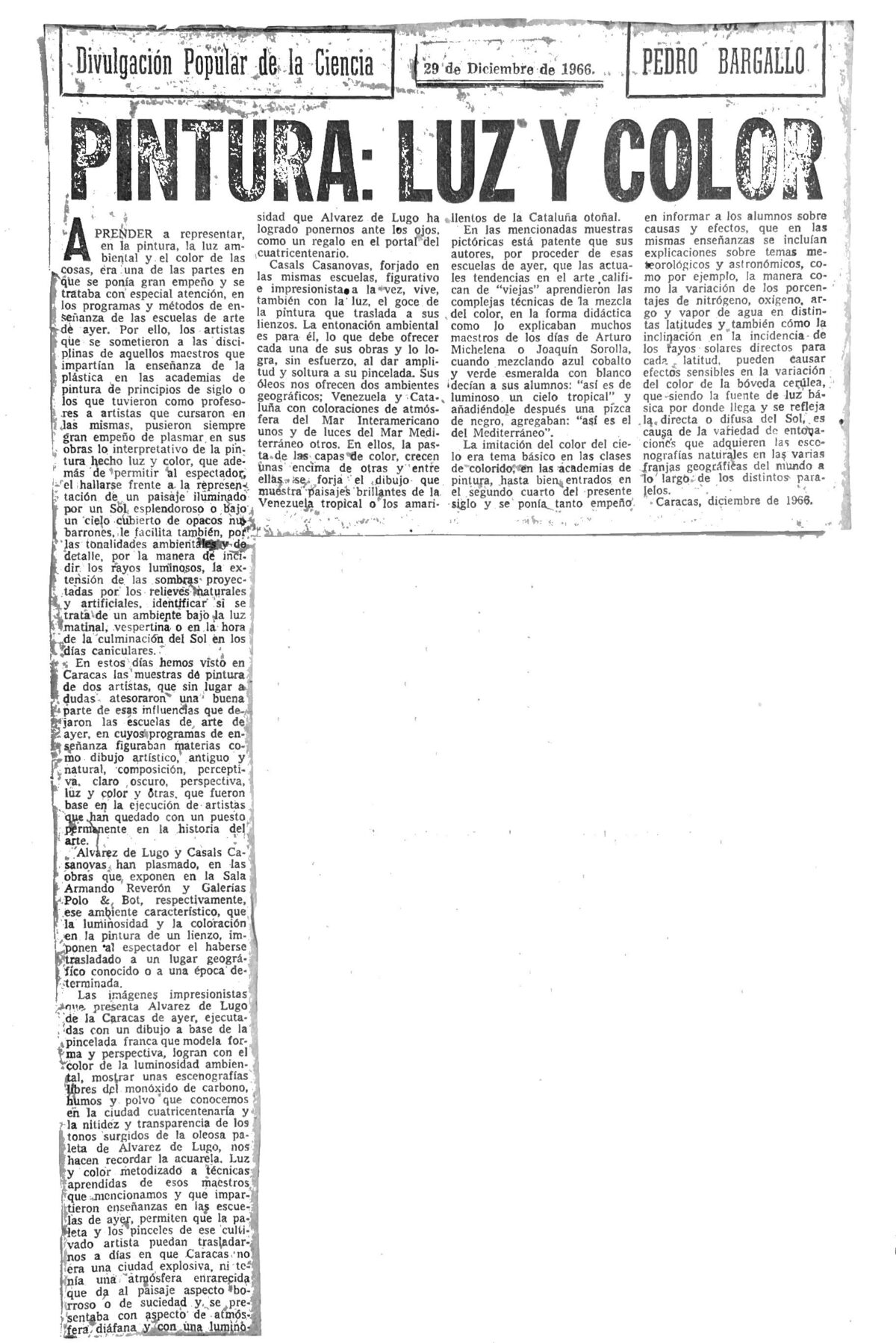
Popular Science Outreach | December 29, 1966 | Pedro Bargalló
PAINTING: LIGHT AND COLOR
Learning to represent, in painting, the environmental light and the color of things was one of the areas of focus handled with special care in the programs and teaching methods of the art schools of yesterday. Therefore, the artists who submitted themselves to the disciplines of those masters who taught visual arts in the painting academies at the beginning of the century—or those who had as professors artists who studied in them—always placed great effort into capturing in their works the interpretative light of painting, light and color which, in addition to “allowing the spectator to find themselves before a representation of a landscape illuminated by a Sun, whether splendid or under a sky covered with dark clouds,” also facilitates, through the environmental tones and details, through the way the luminous rays strike, the extension of shadows projected by natural and artificial reliefs, identifying whether it is an environment under morning or evening light, or at the hour of the Sun’s culmination on dog days.
In these days in Caracas, we have seen the painting exhibitions of two artists who, without a doubt, treasured a good part of those influences that left their mark on the art schools of yesterday, in whose teaching programs subjects such as artistic, ancient and natural drawing, composition, perception, chiaroscuro, perspective, light and color, and others were featured, which were the basis for the execution of artists who have remained with a permanent place in the history of art.
Alvarez de Lugo and Casals Casanovas have captured, in the works they are exhibiting in the Sala Armando Reverón and Galerías Polo & Bot, respectively, that characteristic atmosphere, that luminosity and coloring in the painting of a canvas, which makes the spectator feel as though they have been transported to a known geographical location or a specific era.
The impressionist images that Alvarez de Lugo presents of the Caracas of yesterday, executed with a drawing based on the brushstroke technique that models form and perspective, manage—with the color of environmental luminosity—to show scenes free from carbon monoxide, smoke, and dust that we know in the four-hundred-year-old city; and the clarity and transparency of the tones arising from the oily palette of Alvarez de Lugo make us remember watercolor. Light and color systematized to techniques learned from those masters we mentioned, and who imparted teachings in the schools of yesterday, allow the palette and brushes of this cultivated artist to transport us to days when Caracas was not an explosive city, nor did it have a rarefied atmosphere that gives the landscape a “blurred” appearance of dirt, and presented itself with the appearance of a diaphanous atmosphere and a luminosity that Alvarez de Lugo has managed to place before our eyes, like a gift in the portal of the quadricentennial.
Casals Casanovas, forged in the same schools, figurative and impressionistic at the same time, lives, also with light, the joy of painting that he transfers to his canvases. Environmental intonation is, for him, what each of his works must offer and he achieves it, without effort, by giving breadth and fluency to his brushwork. His oils offer us two geographic environments: Venezuela and Catalonia with atmospheric colorations from the Inter-American Sea and the lights of the Mediterranean. In them, the layering of color grows one upon another and between them, the drawing that shows brilliant landscapes of tropical Venezuela or the yellow tones of autumnal Catalonia is forged.
In the aforementioned pictorial exhibitions, it is evident that their authors, by proceeding from those schools of yesterday—which current trends in art call “old”—learned the complex techniques of color mixing in the didactic way that masters of the days of Arturo Michelena or Joaquín Sorolla explained it, when mixing cobalt blue and emerald green with white they told their students: “this is how a luminous tropical sky is,” and then adding a pinch of black, they added: “this is how the Mediterranean is.”
The imitation of the color of the sky was the basic theme in “coloring” classes in the painting academies until well into the second quarter of the present century and so much effort was put into informing the students about causes and effects, that in the same teachings were included explanations on meteorological and astronomical themes, such as, for example, the way nitrogen, oxygen, argon, and water vapor percentages vary at different latitudes and also how the incidence of direct solar rays at each latitude can cause sensitive effects in the variation of the color of the cerulean vault, which—being the source of light—is basically where it arrives and is reflected, whether direct or diffuse from the Sun, the cause of the variety of intonations acquired by natural topographies in the various geographical strips of the world along the different parallels.
Caracas, December 1966.
Original en Español
Divulgación Popular de la Ciencia | 29 de Diciembre de 1966 | PEDRO BARGALLÓ
PINTURA: LUZ Y COLOR
APRENDER a representar, en la pintura, la luz ambiental y el color de las cosas, era una de las partes en que se ponía gran empeño y se trataba con especial atención, en los programas y métodos de enseñanza de las escuelas de arte de ayer. Por ello, los artistas que se sometieron a las disciplinas de aquellos maestros que impartían la enseñanza de la plástica en las academias de pintura de principios de siglo o los que tuvieron como profesores a artistas que cursaron en las mismas, pusieron siempre gran empeño de plasmar en sus obras lo interpretativo de la pintura, luz y color, que además de “permitir al espectador hallarse frente a la representación de un paisaje iluminado por un Sol, esplendoroso o bajo un cielo cubierto de opacos nubarrones, le facilita también, por las tonalidades ambientales y de detalle, por la manera de incidir los rayos luminosos, la extensión de las sombras proyectadas por los relieves naturales y artificiales, identificar si se trata de un ambiente bajo la luz matinal, vespertina o en la hora de la culminación del Sol en los días caniculares.”
En estos días hemos visto en Caracas las muestras de pintura de dos artistas, que sin lugar a dudas atesoraron una buena parte de esas influencias que dejaron las escuelas de arte de ayer, en cuyos programas de enseñanza figuraban materias como dibujo artístico, antiguo y natural, composición, perceptiva, claro oscuro, perspectiva, luz y color y otras, que fueron base en la ejecución de artistas que han quedado con un puesto permanente en la historia del arte.
Alvarez de Lugo y Casals Casanovas han plasmado, en las obras que exponen en la Sala Armando Reverón y Galerías Polo & Bot, respectivamente, ese ambiente característico, que la luminosidad y la coloración en la pintura de un lienzo, imponen al espectador el haberse trasladado a un lugar geográfico conocido o a una época determinada.
Las imágenes impresionistas que presenta Alvarez de Lugo de la Caracas de ayer, ejecutadas con un dibujo a base de la pincelada franca que modela forma y perspectiva, logran con el color de la luminosidad ambiental, mostrar unas escenografías libres del monóxido de carbono, humos y polvo que conocemos en la ciudad cuatricentenaria; y la nitidez y transparencia de los tonos surgidos de la oleosa paleta de Alvarez de Lugo, nos hacen recordar la acuarela. Luz y color metodizado a técnicas aprendidas de esos maestros que mencionamos y que impartieron enseñanzas en las escuelas de ayer, permiten que la paleta y los pinceles de ese cultivado artista puedan trasladarnos a días en que Caracas no era una ciudad explosiva, ni tenía una atmósfera enrarecida que da al paisaje aspecto “borroso” o de suciedad y se presentaba con aspecto de atmósfera diáfana y con una luminosidad que Alvarez de Lugo ha logrado ponernos ante los ojos, como un regalo en el portal del cuatricentenario.
Casals Casanovas, forjado en las mismas escuelas, figurativo e impresionista a la vez, vive, también con la luz, el goce de la pintura que traslada a sus lienzos. La entonación ambiental es para él, lo que debe ofrecer cada una de sus obras y lo logra, sin esfuerzo, al dar amplitud y soltura a su pincelada. Sus óleos nos ofrecen dos ambientes geográficos; Venezuela y Cataluña con coloraciones de atmósfera del Mar Interamericano y de luces del Mar Mediterráneo. En ellos, la pasta de las capas de color, crecen unas encima de otras y entre ellas se forja el dibujo que muestra paisajes brillantes de la Venezuela tropical o los amarillentos de la Cataluña otoñal.
En las mencionadas muestras pictóricas está patente que sus autores, por proceder de esas escuelas de ayer, que las actuales tendencias en el arte califican de “viejas” aprendieron las complejas técnicas de la mezcla del color, en la forma didáctica como lo explicaban muchos maestros de los días de Arturo Michelena o Joaquín Sorolla, cuando mezclando azul cobalto y verde esmeralda con blanco decían a sus alumnos: “así es de luminoso un cielo tropical” y añadiéndole después una pizca de negro, agregaban: “así es el del Mediterráneo”.
La imitación del color del cielo era tema básico en las clases de “colorido” en las academias de pintura, hasta bien entrados en el segundo cuarto del presente siglo y se ponía tanto empeño en informar a los alumnos sobre causas y efectos, que en las mismas enseñanzas se incluían explicaciones sobre temas meteorológicos y astronómicos, como por ejemplo, la manera como la variación de los porcentajes de nitrógeno, oxígeno, argón y vapor de agua en distintas latitudes y también cómo la incidencia de los rayos solares directos para cada latitud pueden causar efectos sensibles en la variación del color de la bóveda cerúlea, que siendo la fuente de luz básica por donde llega y se refleja la directa o difusa del Sol, es causa de la variedad de entonaciones que adquieren las escenografías naturales en las varias franjas geográficas del mundo a lo largo de los distintos paralelos.
Caracas, diciembre de 1966.