English Translation
BRUJULA
CIVILIAN BOLIVAR
The Case of Colonel De las Casas and the Handover of General Miranda in La Guaira in the Year 1812
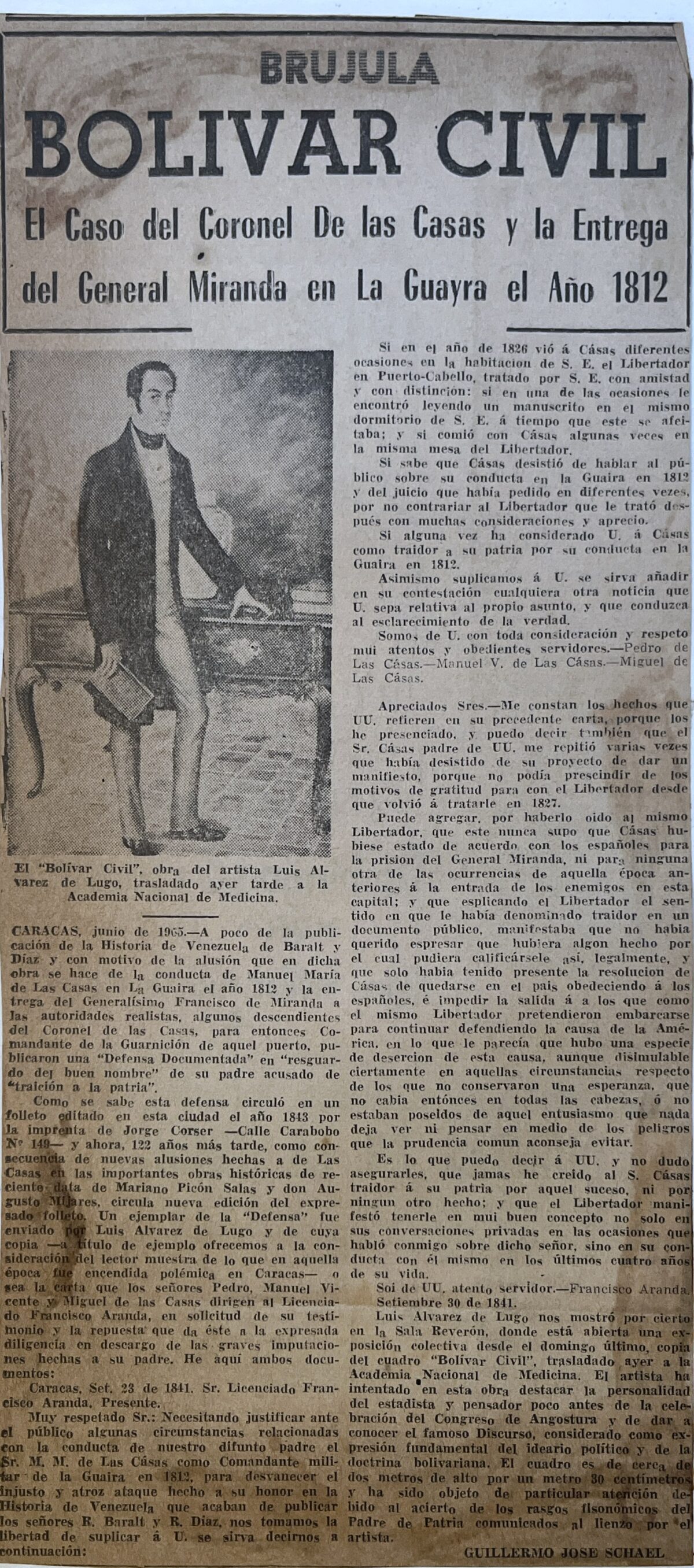
The “Civilian Bolivar,” a work by artist Luis Álvarez de Lugo, transferred yesterday afternoon to the National Academy of Medicine.
CARACAS, June 1965. — Shortly after the publication of the History of Venezuela by Baralt and Díaz, and motivated by the allusion made in said work regarding the conduct of Manuel María de las Casas in La Guaira in the year 1812 and the handover of Generalissimo Francisco de Miranda to the royalist authorities, some descendants of the Colonel of las Casas, then Commander of the Garrison of that port, published a “Documented Defense” to “safeguard the good name” of their father accused of “treason to the homeland.”
As is known, this defense circulated in a pamphlet edited in this city in 1843 by the press of Jorge Corser… and now, 122 years later… a new edition of the aforementioned pamphlet circulates. A copy of the “Defense” was sent by Luis Alvarez de Lugo… as an example, we offer for the reader’s consideration a sample of what in that era was a heated controversy in Caracas—specifically the letter that Messrs. Pedro, Manuel Vicente, and Miguel de las Casas addressed to Licenciado Francisco Aranda, requesting his testimony, and the response he gave to the expressed diligence in dismissal of the serious accusations made against his father. Here are both documents:
Caracas, Sept. 23, 1841. Mr. Licenciado Francisco Aranda, Present.
Most respected Sir: Needing to justify before the public some circumstances related to the conduct of our deceased father, Mr. M. M. de las Casas, as military Commander of La Guaira in 1812, to dispel the unjust and atrocious attack made on his honor in the History of Venezuela just published by Messrs. R. Baralt and R. Díaz, we take the liberty of entreating you to please tell us the following:
If in the year 1828 you saw de las Casas on different occasions in the room of H.E. the Liberator in Puerto Cabello, treated by H.E. with friendship and distinction; if on one of those occasions you found him reading a manuscript in the very bedroom of H.E. while he was shaving; and if he dined with Casas several times at the Liberator’s own table.
If it is known that Casas desisted from speaking to the public about his conduct in La Guaira in 1812 and the judgment he had requested at different times, so as not to contradict the Liberator who treated him later with much consideration and appreciation.
If you have ever considered Mr. de las Casas as a traitor to his homeland for his conduct in La Guaira in 1812.
We likewise entreat you to please add in your reply any other news you know relative to the matter itself, which leads to the clarification of the truth.
We are, with all consideration and respect, your very attentive and obedient servants.—Pedro de las Casas.—Manuel V. de las Casas.—Miguel de las Casas.
[The Response]
Appreciated Sirs.—The facts you refer to in your preceding letter are known to me because I witnessed them, and I can also say that Mr. Casas, your father, repeated to me several times that he had desisted from his project of releasing a manifesto because he could not ignore the motives of gratitude toward the Liberator since he treated him again in 1827.
I can add, having heard it from the Liberator himself, that he never supposed that Casas had been in agreement with the Spaniards for the imprisonment of General Miranda… and that explaining the sense in which he had called him a traitor in a public document, the Liberator manifested that he had not wished to express that there was any act done by him which could be legally qualified as such, but rather he only had in mind the resolution of Casas to remain in the country obeying the Spaniards, instead of departing for America to continue defending the cause…
It is what I can tell you, and I do not doubt in assuring you that I have never believed Mr. Casas a traitor to his country for that event, nor for any other; and that the Liberator manifested having a very good opinion of him… in the last four years of his life.
I am your attentive servant.—Francisco Aranda. September 30, 1841.
Luis Alvarez de Lugo is not shown in the Reverón Hall, where a collective exhibition has been open since last Sunday; a copy of the painting “Civilian Bolivar,” transferred yesterday to the National Academy of Medicine. The artist has attempted in this work to highlight the personality of the statesman and thinker shortly before the celebration of the Congress of Angostura… The painting is nearly two meters high by one meter 30 centimeters…
GUILLERMO JOSE SCHAEL
Original en Español
BRUJULA
BOLIVAR CIVIL
El Caso del Coronel De las Casas y la Entrega del General Miranda en La Guaira el Año 1812
El “Bolívar Civil”, obra del artista Luis Alvarez de Lugo, trasladado ayer tarde a la Academia Nacional de Medicina.
CARACAS, junio de 1965. —A poco de la publicación de la Historia de Venezuela de Baralt y Díaz y con motivo de la alusión que en dicha obra se hace de la conducta de Manuel María de Las Casas en La Guaira el año 1812 y la entrega del Generalísimo Francisco de Miranda a las autoridades realistas, algunos descendientes del Coronel de las Casas, para entonces Comandante de la Guarnición de aquel puerto, publicaron una “Defensa Documentada” en “resguardo del buen nombre” de su padre acusado de “traición a la patria”.
Como se sabe esta defensa circuló en un folleto editado en esta ciudad el año 1843 por la imprenta de Jorge Corser —Calle Carabobo N° 149— y ahora, 122 años más tarde… circula nueva edición del expresado folleto. Un ejemplar de la “Defensa” fue enviado por Luis Alvarez de Lugo… a título de ejemplo ofrecemos a la consideración del lector muestra de lo que en aquella época fue encendida polémica en Caracas— o sea la carta que los señores Pedro, Manuel Vicente y Miguel de las Casas dirigen al Licenciado Francisco Aranda, en solicitud de su testimonio y la repuesta que da éste a la expresada diligencia en descargo de las graves imputaciones hechas a su padre. He aquí ambos documentos:
Caracas, Set. 23 de 1841. Sr. Licenciado Francisco Aranda, Presente.
Muy respetado Sr.: Necesitando justificar ante el público algunas circunstancias relacionadas con la conducta de nuestro difunto padre el Sr. M. M. de Las Casas como Comandante militar de la Guaira en 1812, para desvanecer el injusto y atroz ataque hecho a su honor en la Historia de Venezuela que acaban de publicar los señores R. Baralt y R. Díaz, nos tomamos la libertad de suplicar a U. se sirva decirnos a continuación:
Si en el año de 1828 vió a Casas diferentes ocasiones en la habitación de S. E. el Libertador en Puerto-Cabello, tratado por S. E. con amistad y con distinción; si en una de las ocasiones le encontró leyendo un manuscrito en el mismo dormitorio de S. E. a tiempo que este se afeitaba; y si comió con Casas algunas veces en la misma mesa del Libertador.
Si sabe que Casas desistió de hablar al público sobre su conducta en la Guaira en 1812 y del juicio que había pedido en diferentes veces, por no contrariar al Libertador que le trató después con muchas consideraciones y aprecio.
Si alguna vez ha considerado U. a Casas como traidor a su patria por su conducta en la Guaira en 1812.
Asimismo suplicamos a U. se sirva añadir en su contestación cualquiera otra noticia que U. sepa relativa al propio asunto, y que conduzcan al esclarecimiento de la verdad.
Somos de U. con toda consideración y respeto mui atentos y obedientes servidores.—Pedro de Las Casas.—Manuel V. de Las Casas.—Miguel de Las Casas.
[Respuesta]
Apreciados Sres.—Me constan los hechos que UU. refieren en su precedente carta, porque los he presenciado, y puedo decir también que el Sr. Casas padre de UU. me repitió varias veces que había desistido de su proyecto de dar un manifiesto, porque no podía prescindir de los motivos de gratitud con el Libertador desde que volvió á tratarle en 1827.
Puede agregar, por haberlo oído al mismo Libertador, que este nunca supo que Casas hubiese estado de acuerdo con los españoles para la prisión del General Miranda… y que explicando el Libertador el sentido en que le había denominado traidor en un documento público, manifestaba que no había querido expresar que hubiera algún hecho por el cual pudiera calificársele así, legalmente, y que solo había tenido presente la resolucion de Casas de quedarse en el país obedeciendo a los españoles…
Es lo que puedo decir á UU. y no dudo asegurarles, que jamas he creído al S. Casas traidor á su patria por aquel suceso, ni por ningun otro hecho; y que el Libertador manifestó tenerle en mui buen concepto no solo en sus conversaciones privadas… sino en su conducta con él mismo en los últimos cuatro años de su vida.
Soi de UU. atento servidor.—Francisco Aranda. Setiembre 30 de 1841.
Luis Alvarez de Lugo nos mostró por cierto en la Sala Reverón… copia del cuadro “Bolívar Civil”, trasladado ayer a la Academia Nacional de Medicina. El artista ha intentado en esta obra destacar la personalidad del estadista y pensador poco antes de la celebración del Congreso de Angostura… El cuadro es de cerca de dos metros de alto por un metro 30 centímetros…
GUILLERMO JOSE SCHAEL