English Transcription
TO BE CIRCULATED THIS WEEK
A Fine History of Caracas
Summarized in the Book “Caracas from Century to Century”
By Rafael Ginnari
CARACAS, December 1966. — Amidst the overwhelming bustle of the Caracas of oil and highways, where there is barely room for research and study, the new book by Guillermo José Schael, “Caracas de Siglo a Siglo,” appears as a bastion against modernist pressure. It gives the reader “a bit of a reportage style,” as the author himself states, and in which he confirms, on every page, his pure love for his native city and the desire to reconstruct, historically, the accidental episodes of its civic life.
For us, the outstanding quality of the work is its informative, concise, and straightforward character. Schael goes straight to the point. It is becoming increasingly difficult for the common man to indulge in reading voluminous, heavily documented works, even when they boast a beautiful literary style. Time is of the essence.
The author of “Caracas de Siglo a Siglo” collects and compiles interesting notes related to three different eras of the city’s life. We find the first period particularly suggestive—hitherto little investigated—from the years 1821 to 1830, after Carabobo, “when the city was still living under the ruthless signs of the earthquake and the war.” Leafing through its pages, we find chronicles and anecdotes of the most diverse nature that were the pulse and likeness of an era. For example, the dramatic testimonies of the 1812 earthquake; the account of the construction of the San Francisco temple, whose timbers were brought via the Guaire River—then navigable; the appearance of the Printing Law of the Republic promulgated by the Congress met in El Rosario de Cúcuta from May to October 1821; the advertisement of the “recently arrived fashion tailor from the North”; the price list of daily consumer goods; the sensational escape of two slaves from the house of Mr. José María Muro; picturesque sketches of the Plaza Bolívar, the living and throbbing heart of the city in 1900; the appearance of oil with the almost simultaneous arrival of the automobile and the total transformation they caused in the old structure of Caracas; and finally, an evocative history of the newspaper “EL UNIVERSAL,” provided by Dr. Luis Teófilo Núñez, a journalist who, in his long career, has participated actively in the daily happenings of the city.
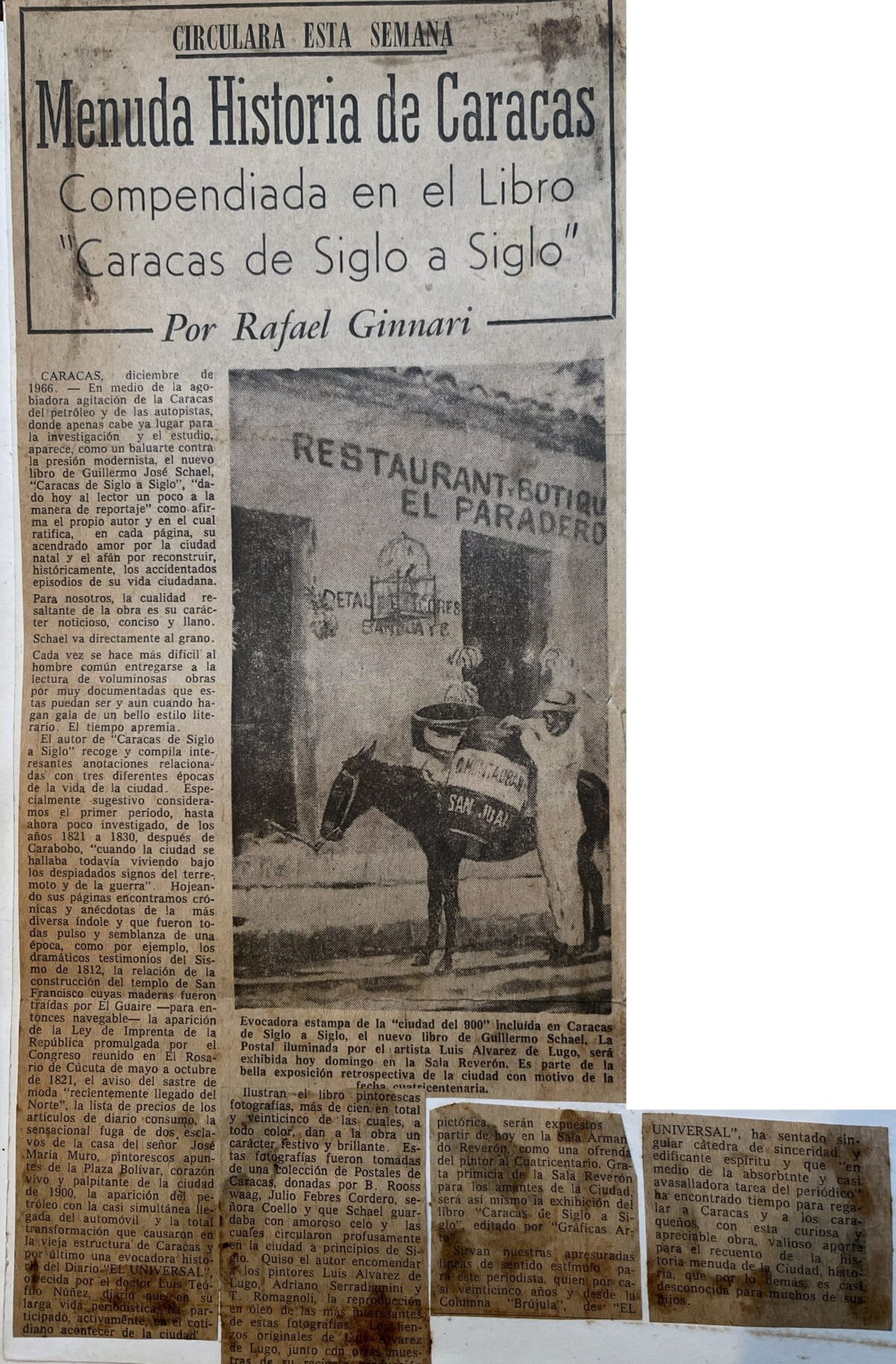
(Caption): An evocative image of the “city of the 1900s” included in Caracas de Siglo a Siglo, the new book by Guillermo Schael. The postcard, colorized by the artist Luis Alvarez de Lugo, will be exhibited today, Sunday, at the Sala Reverón. It is part of the beautiful retrospective exhibition of the city on the occasion of its quadricentennial.
(Bottom left box): The book is illustrated with picturesque photographs, more than a hundred in total, twenty-five of which, in full color, give the work a festive and brilliant character. These photographs were taken from a collection of Caracas Postcards, donated by B. Rooss waag, Julio Febres Cordero, Mrs. Coello, and which Schael kept with loving zeal, and which circulated widely in the city at the beginning of the century. The author wished to commission the painters Luis Alvarez de Lugo, Adriano Serradimigni, and T. Romagnoli to reproduce the most interesting of these photographs in oil. The original canvases by Luis Alvarez de Lugo, along with other samples of his robust… (text cut off)
(Bottom center box): …pictorial work, will be exhibited starting today at the Sala Armando Reverón, as an offering from the painter to the Quadricentennial. A pleasant scoop from the Sala Reverón for city lovers will also be the exhibition of the book “Caracas de Siglo a Siglo,” published by “Gráficas Armitano.”
May our hurried lines serve as a heartfelt encouragement for this journalist, who for nearly twenty-five years and from the “Brújula” column of “EL UNIVERSAL”… (text cut off)
(Bottom right box): …UNIVERSAL,” has established a singular teaching of sincerity and edifying spirit and who “amidst the absorbing and almost overwhelming task of the newspaper” has found time to gift Caracas and its people with this curious and valuable work, a precious contribution to the account of the “fine history” of the city—a history that, moreover, is almost unknown to many of its children.
Transcripción en Español
CIRCULARA ESTA SEMANA
Menuda Historia de Caracas
Compendiada en el Libro “Caracas de Siglo a Siglo”
Por Rafael Ginnari
CARACAS, diciembre de 1966. — En medio de la agobiadora agitación de la Caracas del petróleo y de las autopistas, donde apenas cabe ya lugar para la investigación y el estudio, aparece, como un baluarte contra la presión modernista, el nuevo libro de Guillermo José Schael, “Caracas de Siglo a Siglo”, “dando hoy al lector un poco a la manera de reportaje” como afirma el propio autor y en el cual ratifica, en cada página, su acendrado amor por la ciudad natal y el afán por reconstruir, históricamente, los accidentados episodios de su vida ciudadana.
Para nosotros, la cualidad resaltante de la obra es su carácter noticioso, conciso y llano. Schael va directamente al grano. Cada vez se hace más difícil al hombre común entregarse a la lectura de voluminosas obras por muy documentadas que estas puedan ser y aun cuando hagan gala de un bello estilo literario. El tiempo apremia.
El autor de “Caracas de Siglo a Siglo” recoge y compila interesantes anotaciones relacionadas con tres diferentes épocas de la vida de la ciudad. Especialmente sugestivo consideramos el primer período, hasta ahora poco investigado, de los años 1821 a 1830, después de Carabobo, “cuando la ciudad se hallaba todavía viviendo bajo los despiadados signos del terremoto y de la guerra”. Hojeando sus páginas encontramos crónicas y anécdotas de la más diversa índole y que fueron todas pulso y semblanza de una época, como por ejemplo, los dramáticos testimonios del Sismo de 1812, la relación de la construcción del templo de San Francisco cuyas maderas fueron traídas por El Guaire —para entonces navegable— la aparición de la Ley de Imprenta de la República promulgada por el Congreso reunido en El Rosario de Cúcuta de mayo a octubre de 1821, el aviso del sastre de moda “recientemente llegado del Norte”, la lista de precios de los artículos de diario consumo, la sensacional fuga de dos esclavos de la casa del señor José María Muro, pintorescos apuntes de la Plaza Bolívar, corazón vivo y palpitante de la ciudad de 1900, la aparición del petróleo con la casi simultánea llegada del automóvil y la total transformación que causaron en la vieja estructura de Caracas y por último una evocadora historia del Diario “EL UNIVERSAL”, ofrecida por el doctor Luis Teófilo Núñez, diario quien en su larga vida periodística, ha participado, activamente, en el cotidiano acontecer de la ciudad.
(Pie de foto): Evocadora estampa de la “ciudad del 900” incluida en Caracas de Siglo a Siglo, el nuevo libro de Guillermo Schael. La Postal iluminada por el artista Luis Alvarez de Lugo, será exhibida hoy domingo en la Sala Reverón. Es parte de la bella exposición retrospectiva de la ciudad con motivo de la fecha cuatricentenaria.
(Recuadro inferior izquierdo): Ilustran el libro pintorescas fotografías, más de cien en total y veinticinco de las cuales, a todo color, dan a la obra un carácter festivo y brillante. Estas fotografías fueron tomadas de una colección de Postales de Caracas, donadas por B. Rooss waag, Julio Febres Cordero, señora Coello y que Schael guardaba con amoroso celo y las cuales circularon profusamente en la ciudad a principios de Siglo. Quiso el autor encomendar a los pintores Luis Alvarez de Lugo, Adriano Serradimigni y T. Romagnoli, la reproducción en óleo de las más interesantes de estas fotografías. Los lienzos originales de Luis Alvarez de Lugo, junto con otras muestras de su recia… (texto cortado)
(Recuadro inferior central): …pictórica, serán expuestos a partir de hoy en la Sala Armando Reverón, como una ofrenda del pintor al Cuatricentenario. Grata primicia de la Sala Reverón para los amantes de la Ciudad, será así mismo la exhibición del libro “Caracas de Siglo a Siglo”, editado por “Gráficas Armitano”.
Sirvan nuestras apresuradas líneas de sentido estímulo para este periodista, quien por casi veinticinco años y desde la Columna “Brújula”, de “EL UNIVERSAL”… (texto cortado)
(Recuadro inferior derecho): …UNIVERSAL”, ha sentado singular cátedra de sinceridad y edificante espíritu y que “en medio de la absorbente y casi avasalladora tarea del periódico” ha encontrado tiempo para regalar a Caracas y a los caraqueños, con esta curiosa y apreciable obra, valioso aporte para el recuento de la historia menuda de la Ciudad, historia, que por lo demás, es casi desconocida para muchos de sus hijos.