English Translation
Cronica de Artes Plásticas (Visual Arts Chronicle)
Balance of Our Painting in 1968
By Oscar Rojas Jiménez
As 1968 concludes, the first observation we make is that this year has been very fruitful for the visual arts in Venezuela. It is, of course, impossible to summarize in a few lines the numerous activities held in Museums and Galleries. As we have written before, most of the great Venezuelan painters have exhibited, with the exception of the Masters Manuel Cabré and Pedro Ángel González, due to personal reasons and a certain “allergy” to individual exhibitions. National tributes to these two great values are imposed, with retrospectives that will truly amaze. They have painted much with a true vocational spirit and have earned our esteem.
In the Galleries, many good exhibitions by national painters have been presented. Aside from the collective exhibitions, we have witnessed good exhibitions at the Sala Mendoza, Galería Acquavella, Arte Moderno, Isla, Marcos Castillo, Museo de Bellas Artes, Galería XX2, El Muro, etc.
Good exhibitions by Venezuelan artists this year at Arte Moderno, “la de Francisco Narváez and that of Luis Alfredo López Méndez. In Narváez, we find the artist of always, sure of himself and with an unbreakable vocation. But the public continues to see in Narváez the great sculptor of Venezuela, relegating his painting to a second plane. At least that is the general opinion. Certainly, the sculptor-painter seems to feel with greater emotion the stone or wood than the brushes. López Méndez also presented this year. It was with a series of oils with motifs of Greece that caused a spectacular curiosity. The themes were varied and mostly anecdotal, but the veteran painter that is López Méndez managed to overcome some pitfalls. Surely the greatest success of these paintings is in the strong color that predominated in them. He knows how to communicate the painter to his work. Also, the magnificent retrospective of Alcántara.
Acquavella presented recently, to close the year, a set of works by national artists of very good quality and especially some works by old artists who have passed away. During the year, they presented an original exhibition, Guri, National Painting Prize, only with themes and musical instruments. Acquavella also presented a good exhibition of enamels by the artist Yuye de Lima.
In the Marcos Castillo gallery, specialized in the presentation of promising young artists, we saw two good exhibitions: one by the artist Guillermo Márquez, who sometimes paints on scraps of newspaper and other materials of short durability, which we criticize despite his work starting with good omens; but he must settle and at the same time take care of himself for the future. Márquez is certainly an artist with great sensitivity and still has much to learn. But apart from these observations, we are in the presence of one of our good young artists. In the same room, one of the most important exhibitions of the year was presented: The Retrospective of Armando Reverón. The originality and novelty of this exhibition resided in the fact that for the first time the public saw works by the solitary of Macuto belonging to private collections, never before exhibited. Without critical spirit, let us say that they confirm the high opinion we have formed—once again—of his extraordinary value, surely not yet surpassed in the history of our painting. On the occasion of the presentation of this very successful retrospective, we wrote our judgment on the mastery of the great artist.
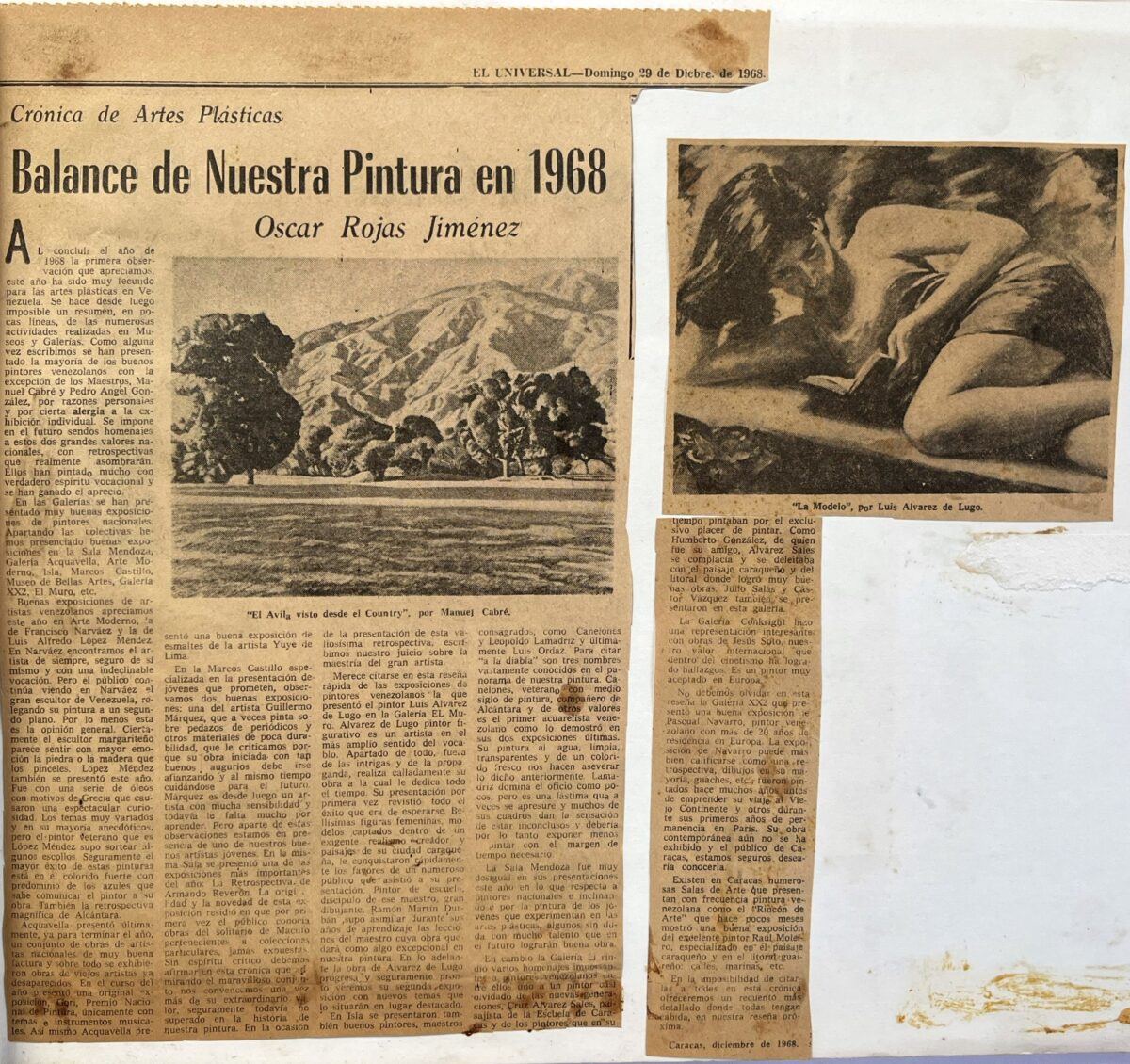
It is worth mentioning in this quick review of the exhibitions of Venezuelan painters the one presented by the painter Luis Alvarez de Lugo in the El Muro Gallery. Alvarez de Lugo, a figurative painter, is an artist in the broadest sense of the word. Set apart from everything, from intrigue and propaganda, he works quietly on the work to which he dedicates all his time. His presentation for the first time revisited all the success that was to be expected. Beautiful female figures, masterfully captured within a demanding “creative realism” and landscapes of his city, Caracas, quickly conquered the favors of a numerous public that attended his presentation. A school painter, a disciple of that great master, the great draftsman Ramón Martín Durbán, he knew how to assimilate during his years of learning the lessons of the master whose work will give as something exceptional in our painting. In the future, the work of Alvarez de Lugo will progress and surely soon we will see his second exhibition with new themes that will place him in a prominent place.
In Isla, established masters such as Cabré, Manuel Cabré, Canelones, and Leopoldo Lamadriz and finally Luis Ordaz were presented. To cite “at random” are three names vastly known in the panorama of our painting. Canelones, a veteran with half a century of painting, companion of Alcántara and other values, is the first Venezuelan watercolorist as he demonstrated in his last two exhibitions. His painting of water, clean, transparent, and of a fresh coloring makes us assert what was said previously. Lamadriz masters the trade as few do, but it is a pity that sometimes he rushes and many of his paintings give the sensation of being unfinished and colorless, therefore needing to exhibit with less frequency and paint with the necessary margin of time.
The Sala Mendoza was very unequal in its presentations this year regarding national painters and inclined toward the painting of the young who experiment in the visual arts, some undoubtedly with much talent who in the future will achieve good work.
In the Galería La Rinconada, various tributes were paid to Venezuelan painters, among them a almost forgotten painter by the new generations, Cruz Alvarez Sales, a landscaper of the School of Caracas and of the painters who in their time painted for the exclusive pleasure of painting. Like Humberto González, of whom he was his friend, Alvarez Sales delighted and took pleasure with the landscape of Caracas and the coastline where he achieved very good works. Justo Salas and Cástor Vásquez also presented at this gallery.
The Conkright Gallery made an interesting representation with works by Jesús Soto, our international value who within kineticism has achieved findings. He is a painter very accepted in Europe.
We must not forget in this review the XX2 Gallery which presented a good exhibition by Pascual Navarro, a Venezuelan painter with more than 20 years of residence in Europe. Navarro’s exhibition can be described as a retrospective; drawings for the most part, gouaches, etc., were paintings made many years ago before undertaking his trip to the Old Continent and others during his first years of residence in Paris. His contemporary work has not yet been exhibited and the public of Caracas, we are sure, would like to know it.
Numerous Art Rooms exist in Caracas that frequently present Venezuelan painting, such as the “Rincón del Arte” which a few months ago showed a good exhibition of the excellent painter Raúl Moleiro, specialized in the landscape of Caracas and the coastal-Guaira region, marines, etc.
Faced with the impossibility of citing them all in this chronicle, we will offer a more detailed account later where everyone has a place, in our next review.
Caracas, December 1968.
Original en Español
Crónica de Artes Plásticas
Balance de Nuestra Pintura en 1968
Por Oscar Rojas Jiménez
Al concluir el año de 1968 la primera observación que apreciamos, este año ha sido muy fecundo para las artes plásticas en Venezuela. Se hace desde luego imposible un resumen, en pocas líneas, de las numerosas actividades realizadas en Museos y Galerías. Como alguna vez escribimos se han presentado la mayoría de los buenos pintores venezolanos con la excepción de los Maestros, Manuel Cabré y Pedro Ángel González, por razones personales y por cierta alergia a la exhibición individual. Se impone en el futuro sendos homenajes a estos dos grandes valores nacionales, con retrospectivas que realmente asombrarán. Ellos han pintado mucho con verdadero espíritu vocacional y se han ganado el aprecio.
En las Galerías se han presentado muy buenas exposiciones de pintores nacionales. Apartando las colectivas hemos presenciado buenas exposiciones en la Sala Mendoza, Galería Acquavella, Arte Moderno, Isla, Marcos Castillo, Museo de Bellas Artes, Galería XX2, El Muro, etc.
Buenas exposiciones de artistas venezolanos apreciamos este año en Arte Moderno, la de Francisco Narváez y la de Luis Alfredo López Méndez. En Narváez encontramos el artista de siempre, seguro de sí mismo y con una indeclinable vocación. Pero el público continúa viendo en Narváez el gran escultor de Venezuela, relegando su pintura a un segundo plano. Por lo menos esta es la opinión general. Ciertamente el escultor-pintor parece sentir con mayor emoción la piedra o la madera que los pinceles. López Méndez también se presentó este año. Fue con una serie de óleos con motivos de Grecia que causaron una espectacular curiosidad. Los temas muy variados y en su mayoría anecdóticos, pero el pintor veterano que es López Méndez supo sortear algunos escollos. Seguramente el mayor éxito de estas pinturas está en el colorido fuerte que predominó en ellos. Sabe comunicar el pintor a su obra. También la retrospectiva magnífica de Alcántara.
Acquavella presentó últimamente, para terminar el año, un conjunto de obras de artistas nacionales de muy buena factura y sobre todo se exhibieron obras de viejos artistas ya desaparecidos. En el curso del año presentó una original exposición, Guri, Premio Nacional de Pintura, únicamente con temas e instrumentos musicales. Así mismo Acquavella presentó una buena exposición de esmaltes de la artista Yuye de Lima.
En la Marcos Castillo especializada en la presentación de jóvenes que prometen, observamos dos buenas exposiciones: una del artista Guillermo Márquez, que a veces pinta sobre pedazos de periódicos y otros materiales de poca durabilidad, que le criticamos por que su obra iniciada con tan buenos augurios debe irse afianzando y al mismo tiempo cuidándose para el futuro. Márquez es desde luego un artista con mucha sensibilidad y todavía le falta mucho por aprender. Pero aparte de estas observaciones estamos en presencia de uno de nuestros buenos artistas jóvenes. En la misma Sala se presentó una de las exposiciones más importantes del año: La Retrospectiva de Armando Reverón. La originalidad y la novedad de esta exposición residió en que por primera vez el público conocía obras del solitario de Macuto pertenecientes a colecciones particulares, jamás expuestas. Sin espíritu crítico debemos afirmar que ésta confirma una vez más el maravilloso conjunto que nos convencemos—una vez más—de su extraordinario valor, seguramente todavía no superado en la historia de nuestra pintura. En la ocasión de la presentación de esta valiosísima retrospectiva, escribimos nuestro juicio sobre la maestría del gran artista.
Merece citarse en esta reseña rápida de las exposiciones de pintores venezolanos la que presentó el pintor Luis Alvarez de Lugo en la Galería El Muro. Alvarez de Lugo pintor figurativo es un artista en el más amplio sentido del vocablo. Apartado de todo, fue a de las intrigas y de la propaganda, realiza calladamente su obra a la cual le dedica todo el tiempo. Su presentación por primera vez revistió todo el éxito que era de esperarse. Bellas figuras femeninas, modelos captados dentro de un exigente “realismo creador” y paisajes de su ciudad caraqueña, le conquistaron rápidamente los favores de un numeroso público que asistió a su presentación. Pintor de escuela, discípulo de ese maestro, gran dibujante, Ramón Martín Durbán, supo asimilar durante sus años de aprendizaje las lecciones del maestro cuya obra que dará como algo excepcional en nuestra pintura. En lo adelante la obra de Alvarez de Lugo progresará y seguramente pronto lo veremos su segunda exposición con nuevos temas que lo situarán en lugar destacado.
En Isla se presentaron también buenos pintores, maestros consagrados, como Cabré, Manuel Cabré, Canelones y Leopoldo Lamadriz y últimamente Luis Ordaz. Para citar “a la diabla” son tres nombres vastamente conocidos en el panorama de nuestra pintura. Canelones, veterano con medio siglo de pintura, compañero de Alcántara y de otros valores es el primer acuarelista venezolano como lo demostró en sus dos exposiciones últimas. Su pintura al agua, limpia, transparentes y de un colorido fresco nos hacen aseverar lo dicho anteriormente. Lamadriz domina el oficio como pocos, pero es una lástima que a veces se apresure y muchos de sus cuadros dan la sensación de estar inconclusos y descoloridos por lo tanto exponer menos pintar con el margen de tiempo necesario.
La Sala Mendoza fue muy desigual en sus presentaciones este año en lo que respecta a pintores nacionales e inclinándose por la pintura de los jóvenes que experimentan en las artes plásticas, algunos sin duda con mucho talento que en el futuro lograrán buena obra.
En cambio la Galería La Rinconada varios homenajes impusieron a pintores venezolanos entre ellos uno a un pintor casi olvidado de las nuevas generaciones, Cruz Alvarez Sales, paisajista de la Escuela de Caracas y de los pintores que en su tiempo pintaban por el exclusivo placer de pintar. Como Humberto González, de quien fue su amigo, Alvarez Sales se complacía y se deleitaba con el paisaje caraqueño y del litoral donde logró muy buenas obras. Justo Salas y Cástor Vázquez también se presentaron en esta galería.
La Galería Conkright hizo una representación interesante con obras de Jesús Soto, nuestro valor internacional que dentro del cinetismo ha logrado hallazgos. Es un pintor muy aceptado en Europa.
No debemos olvidar en esta reseña la Galería XX2 que presentó una buena exposición de Pascual Navarro, pintor venezolano con más de 20 años de residencia en Europa. La exposición de Navarro puede más bien calificarse como una retrospectiva, dibujos en su mayoría, guaches, etc., fueron pintados hace muchos años antes de emprender su viaje al Viejo Continente y otros durante sus primeros años de permanencia en París. Su obra contemporánea aún no se ha exhibido y el público de Caracas, estamos seguros, desearía conocerla.
Existen en Caracas numerosas Salas de Arte que presentan con frecuencia pintura venezolana como el “Rincón del Arte” que hace pocos meses mostró una buena exposición del excelente pintor Raúl Moleiro, especializado en el paisaje caraqueño y en el litoral-guaireño, calles, marinas, etc.
En la imposibilidad de citarlas a todas en esta crónica ofreceremos un recuento más detallado donde todas tengan cabida, en nuestra reseña próxima.
Caracas, diciembre de 1968.