English Translation
Compass
The Plaza Mayor of April 19th
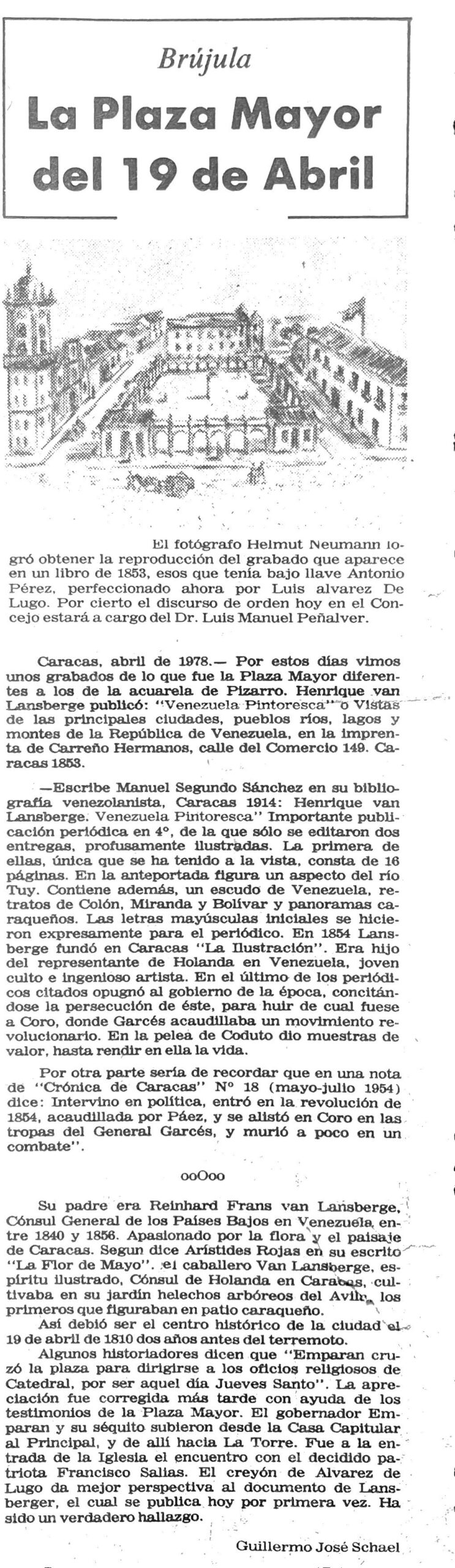
The photographer Helmut Neumann managed to obtain a reproduction of the engraving that appears in a book from 1853—one of those kept under lock and key by Antonio Pérez—now perfected by Luis Alvarez De Lugo. Incidentally, today’s keynote speech at the Council will be delivered by Dr. Luis Manuel Peñalver.
Caracas, April 1978.— These days we saw some engravings of what the Plaza Mayor used to be, different from those in Pizarro’s watercolor. Henrique van Lansberge published: “Venezuela Pintoresca” (Picturesque Venezuela) or Views of the main cities, towns, rivers, lakes, and mountains of the Republic of Venezuela, at the Carreño Hermanos printing house, 149 Comercio Street. Caracas 1853.
—Manuel Segundo Sánchez writes in his Venezuelanist bibliography, Caracas 1914: Henrique van Lansberge: “Venezuela Pintoresca,” an important periodical publication in 4to, of which only two issues were published, profusely illustrated. The first of them, the only one that has been seen, consists of 16 pages. The frontispiece features a view of the Tuy River. It also contains a coat of arms of Venezuela, portraits of Columbus, Miranda, and Bolívar, and panoramas of Caracas. The initial capital letters were made specifically for the newspaper. In 1854, Lansberge founded “La Ilustración” in Caracas. He was the son of the Dutch representative in Venezuela, a cultured young man and an ingenious artist. In the latter of the aforementioned newspapers, he opposed the government of the time, inciting their persecution; to flee from them, he went to Coro, where Garcés led a revolutionary movement. In the battle of Coduto, he showed signs of bravery, until he gave his life in it.
On the other hand, it is worth remembering that a note in “Crónica de Caracas” No. 18 (May-July 1954) states: “He intervened in politics, joined the revolution of 1854 led by Páez, enlisted in Coro in the troops of General Garcés, and died shortly after in combat.”
oOoOo
His father was Reinhard Frans van Lansberge, Consul General of the Netherlands in Venezuela between 1840 and 1856. He was passionate about the flora and landscape of Caracas. According to Arístides Rojas in his writing “La Flor de Mayo,” the gentleman Van Lansberge—an enlightened spirit and Consul of Holland in Caracas—cultivated tree ferns from El Ávila in his garden, the first to appear in a Caracas patio.
This is likely how the city’s historical center looked on April 19, 1810, two years before the earthquake.
Some historians say that “Emparan crossed the plaza to attend religious services at the Cathedral, as it was Maundy Thursday.” This assessment was later corrected with the help of testimonies from the Plaza Mayor. Governor Emparan and his retinue went up from the Casa Capitular to the Principal, and from there toward La Torre. It was at the entrance of the church where the encounter with the determined patriot Francisco Salias took place. Alvarez de Lugo’s crayon work gives a better perspective to Lansberge’s document, which is published today for the first time. It has been a true discovery.
Guillermo José Schael
Transcripción en Español
Brújula
La Plaza Mayor del 19 de Abril
El fotógrafo Helmut Neumann logró obtener la reproducción del grabado que aparece en un libro de 1853, esos que tenía bajo llave Antonio Pérez, perfeccionado ahora por Luis Alvarez De Lugo. Por cierto el discurso de orden hoy en el Concejo estará a cargo del Dr. Luis Manuel Peñalver.
Caracas, abril de 1978.— Por estos días vimos unos grabados de lo que fue la Plaza Mayor diferentes a los de la acuarela de Pizarro. Henrique van Lansberge publicó: “Venezuela Pintoresca” o Vistas de las principales ciudades, pueblos ríos, lagos y montes de la República de Venezuela, en la imprenta de Carreño Hermanos, calle del Comercio 149. Caracas 1853.
—Escribe Manuel Segundo Sánchez en su bibliografía venezolanista, Caracas 1914: Henrique van Lansberge: Venezuela Pintoresca” importante publicación periódica en 4°, de la que sólo se editaron dos entregas, profusamente ilustradas. La primera de ellas, única que se ha tenido a la vista, consta de 16 páginas. En la anteportada figura un aspecto del río Tuy. Contiene además, un escudo de Venezuela, retratos de Colón, Miranda y Bolívar y panoramas caraqueños. Las letras mayúsculas iniciales se hicieron expresamente para el periódico. En 1854 Lansberge fundó en Caracas “La Ilustración”. Era hijo del representante de Holanda en Venezuela, joven culto e ingenioso artista. En el último de los periódicos citados opugnó al gobierno de la época, concitándose la persecución de éste, para huir de cual fuese a Coro, donde Garcés acaudillaba un movimiento revolucionario. En la pelea de Coduto dio muestras de valor, hasta rendir en ella la vida.
Por otra parte sería de recordar que en una nota de “Crónica de Caracas” Nº 18 (mayo-julio 1954) dice: Intervino en política, entró en la revolución de 1854, acaudillada por Páez, y se alistó en Coro en las tropas del General Garcés, y murió a poco en un combate”.
oOoOo
Su padre era Reinhard Frans van Lansberge, Cónsul General de los Países Bajos en Venezuela entre 1840 y 1856. Apasionado por la flora y el paisaje de Caracas. Según dice Arístides Rojas en su escrito “La Flor de Mayo”, el caballero Van Lansberge, espíritu ilustrado, Cónsul de Holanda en Caracas, cultivaba en su jardín helechos arbóreos del Avila, los primeros que figuraban en patio caraqueño.
Así debió ser el centro histórico de la ciudad el 19 de abril de 1810 dos años antes del terremoto.
Algunos historiadores dicen que “Emparan cruzó la plaza para dirigirse a los oficios religiosos de Catedral, por ser aquel día Jueves Santo”. La apreciación fue corregida más tarde con ayuda de los testimonios de la Plaza Mayor. El gobernador Emparan y su séquito subieron desde la Casa Capitular al Principal, y de allí hacia La Torre. Fue a la entrada de la Iglesia el encuentro con el decidido patriota Francisco Salias. El creyón de Alvarez de Lugo da mejor perspectiva al documento de Lansberge, el cual se publica hoy por primera vez. Ha sido un verdadero hallazgo.
Guillermo José Schael