
English Translation
EL UNIVERSAL, Friday, October 29, 1982
The Liberator’s Name Day
By Guillermo José Schael
[Image Caption: Equestrian statue of the Liberator, a version by Caracas artist Luis Alvarez de Lugo, who is currently executing his first works in the field of sculpture.]
Yesterday afternoon, on the occasion of the Liberator’s name day, a lecture series was inaugurated at the headquarters of the Bolivarian Society. These lectures will be held throughout the bicentennial year and were opened by the President of the Republic, Dr. Luis Herrera Campíns. By authorization of the board of directors, the series has been coordinated by Doctors Mario Briceño Perozo, Oscar Beaujón, and the writer Oscar Rojas Jiménez.
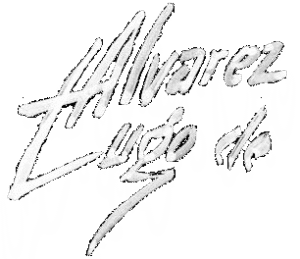
CARACAS, October 1982 — Today was the feast of Saint Simon. The well-known painter of Caracas themes, Luis Alvarez de Lugo, after a two-year hiatus—part of which was spent perfecting himself in sculpture and bronze casting at the school of North American artist Eugenio Shortridge in Sarasota, Florida—now surprises us with a free interpretation of an equestrian Simón Bolívar. The profile of the Liberator in this work recalls François Roulin and Carmelo Fernández, although the personal interpretation of the artist predominates. He is also the author of the civilian Bolívar located in the assembly hall of the National Academy of Medicine. Alvarez de Lugo has specialized for many years in the study of human and equine anatomy, to bring it now not only to painting but to bronze in all its dimensions.
As the bicentennial date of the birth of the Father of the Country approaches, he creates this sculpture. It is a modest tribute to his memory on such an important date.
—Among the equestrian statues of Bolívar that are known—we ask him—which one do you like most?
—”Although the works by Tadolini in Lima and by Weldon in Washington are very good,” he responds, “I like Canónica’s in Rome very much.” His inner circle has been surprised by the interpretation Alvarez makes of the horse’s anatomy, incorporating it into the outstanding image of the Liberator.
By the way, we were commenting with the painter and now sculptor on the witty content of the letter written by the Liberator to Mr. B. Irvine, a U.S. agent, in Bogotá on October 7, 1818, after the latter made a rather inappropriate comment regarding the capture of the gunboats (flecheras) in the Apure: “The proverb of swimming cavalry, if there has ever been one,” Bolívar tells him, “must refer to the brilliant and glorious days in which small patriot corps of this arm have crossed the powerful rivers Caura, Caroní, and Apure, dislodging and defeating the Spanish troops that opposed them and boarding warships. Love for the fatherland and for glory alone have directed these enterprises which, far from being laughable, deserve the admiration and applause of those who have a fatherland and love their freedom. I repeat to Your Lordship what I have said above, begging you to reread my official letter of the 29th with more attention. It is necessary to wish to distort its meaning and invert its phrases for Your Lordship to attribute to yourself what I said about the news they had received privately from sources that, in truth, are not poorly informed but biased.” The letter was sent from Angostura on October 7, 1818, the year in which Bolívar and his staff were preparing the southern campaign.
///
In an oil painting whose dimensions are $1.16 \times 0.90$, also executed by the artist Alvarez de Lugo for the bicentennial date, he presents us with a Bolívar on horseback with Mount Avila in the background. We recall the lines written by the Liberator to General José Antonio Páez from Oruro, Upper Peru, on September 26, 1825, announcing his love for the city: “A thousand leagues will occupy my arms, but my heart will always be in Caracas; there I received life, there I should give it back, and the people of Caracas will always be my first fellow citizens. This feeling will not abandon me until after death.”
A year ago, the publisher Ernesto Armitano reproduced, with the authorization of Dr. Ignacio de Guzmán Noguera, the author of the magnificent work “The Thought of the Liberator,” a kind of dictionary where interested parties can instantly find his ideas classified in alphabetical order from “A” for Abatimiento (Dejection) to “Z” for Zuazola.
Transcripción Original (Español)
EL UNIVERSAL, Viernes 29 de Octubre de 1982
Onomástico del Libertador
Guillermo José Schael
[Pie de foto: Estatua ecuestre del Libertador, versión del artista caraqueño Luis Alvarez de Lugo, quien ejecuta por estos días sus primeras obras en el campo de la escultura.]
Ayer por la tarde con motivo del onomástico del Libertador se inauguró en la sede de la Sociedad Bolivariana el ciclo de conferencias que se celebrará durante el año bicentenario y la cual estuvo a cargo del presidente de la República Dr. Luis Herrera Campíns. Por autorización de la junta directiva, el ciclo ha sido coordinado por los doctores Mario Briceño Perozo, Oscar Beaujón y el escritor Oscar Rojas Jiménez.
CARACAS, octubre de 1982 — Hoy fue el día de San Simón. El conocido pintor de temas caraqueños Luis Alvarez de Lugo, después de un receso de dos años, parte de los cuales transcurrió perfeccionándose en la escultura y el vaciado en bronce en la escuela de Sarasota, Florida, que dirige el afamado artista norteamericano Eugenio Shortridge, nos sorprende ahora con una interpretación libre de un Simón Bolívar ecuestre. El perfil del Libertador en esta obra recuerda a Francois Roulin y a Carmelo Fernández, aunque predomina la interpretación personal del artista, autor también del Bolívar civil que se halla en la sala de asambleas de la Academia Nacional de Medicina. Alvarez de Lugo se ha especializado desde hace muchos años en el estudio de la anatomía de la figura humana y del caballo, para llevarla no solamente a la pintura sino ahora al bronce en toda su dimensión.
Al acercarse la fecha bicentenaria del nacimiento del Padre de la Patria realiza esta escultura. Es modesto homenaje a su memoria en tan importante fecha.
—Entre las estatuas ecuestres que se conocen de Bolívar —le preguntamos— ¿cuál le agrada más?
—Aunque son muy buenas las obras de Tadolini en Lima y de Weldon en Washington —responde— me gusta mucho la de Canónica en Roma. Ha sorprendido a sus allegados la interpretación que hace Alvarez de la anatomía del caballo incorporándola a la sobresaliente imagen del Libertador.
Por cierto que comentábamos con el pintor y ahora escultor el gracioso contenido de la carta que escribe el Libertador al Sr. E. Irvine, agente de EEUU, en Bogotá el 7 de octubre de 1818 por haber hecho éste un comentario no muy apropiado a la toma de las flecheras en el Apure: —El proverbio de la caballería nadadora, si es que lo ha sido —le dice Bolívar— debe aludir a las brillantes y gloriosas jornadas en que pequeños cuerpos patriotas de esta arma han atravesado a nado los caudalosos ríos Caura, Caroní y Apure, desalojando y batiendo las tropas españolas que se l1es oponían y abordando buques de guerra. El amor a la patria y a 2la gloria sólo han dirigido estas empresas que, lejos de ser risible, merecen la admiración y aplausos de los que tienen una patria y aman su libertad. Repito a V.S. lo que he dicho arriba suplicándole relea con más atención mi oficio del 29. Es preciso querer trastornar su sentido e invertir sus frases para atribuirse V.S. lo que yo decía de las noticias que han recibido privadamente de fuentes que, a la verdad, no están mal instruidas sino viciadas. La carta fue puesta en Angostura a 7 de octubre de 1818, año en que Bolívar con su estado mayor preparaba la campaña del sur.
///
En un cuadro al óleo cuyas dimensiones son el $1,16 \times 0,90$ realizado igualmente por el artista Alvarez de Lugo con motivo a la fecha bicentenaria nos presenta un Bolívar a caballo teniendo como fondo el cerro del Avila. Recordamos las líneas que escribe el Libertador al general José Antonio Páez desde Oruro, Alto Perú, el 26 de septiembre de 1825 anunciándole su amor por la ciudad: “Mil leguas le ocuparán mis brazos, pero mi corazón se hallará siempre en Caracas; allí recibí la vida, allí debo rendirla y los caraqueños serán siempre mis primeros compatriotas. Este sentimiento no me abandonará sino3 hasta después de la muerte”.
Hace un año el editor Ernesto Armitano reprodujo con autorización del Dr. Ignacio de Guzmán Noguera autor de la magnífica obra “El Pensamiento del Libertador” especie de diccionario donde los interesados pueden encontrar en el acto sus ideas clasificadas por orden alfabético desde la “A” de Abatimiento hasta la “Z” de Zuazola.