English Translation
Alvarez de Lugo Will Exhibit in Paris By: KALININA ORTEGA
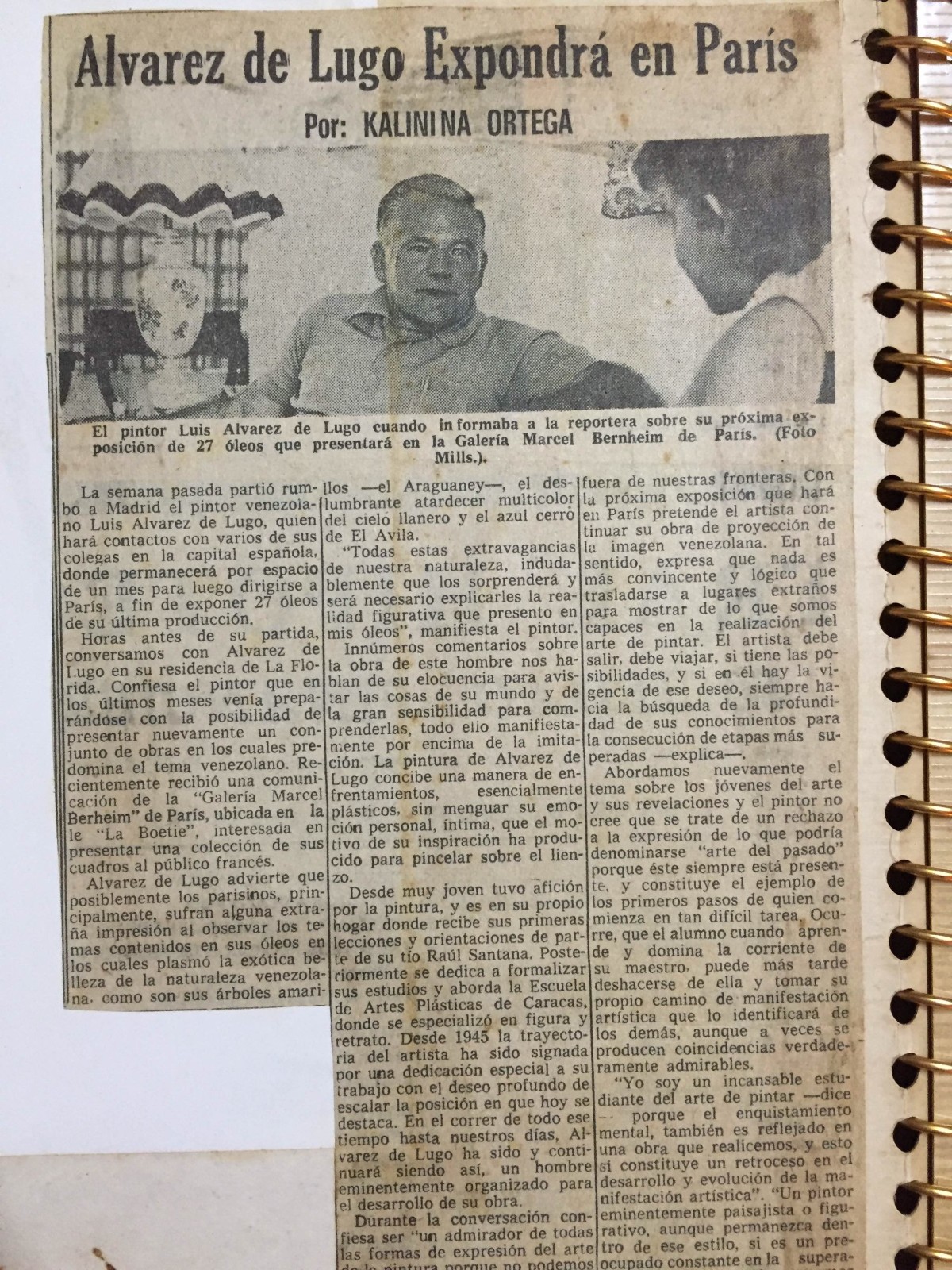
(Caption under the photo: Painter Luis Alvarez de Lugo while informing the reporter about his upcoming exhibition of 27 oil paintings to be presented at the Marcel Bernheim Gallery in Paris. Photo: Mills).
Last week, the Venezuelan painter Luis Alvarez de Lugo left for Madrid. He will make contact with several colleagues in the Spanish capital, where he will stay for a month before heading to Paris to exhibit 27 oil paintings from his latest production.
Hours before his departure, we spoke with Alvarez de Lugo at his residence in La Florida. The painter confesses that in recent months he has been preparing for the possibility of once again presenting a group of works in which the Venezuelan theme predominates. Recently, he received a communication from the “Marcel Bernheim Gallery” in Paris, located on “La Boetie” [Street], interested in presenting a collection of his paintings to the French public.
Alvarez de Lugo warns that the Parisians might experience some strange impression when observing the themes contained in his oil paintings, in which he captured the exotic beauty of Venezuelan nature, such as his yellow trees—the Araguaney—, the dazzling multicolored sunset of the plains sky, and the blue hill of El Avila.
“All these extravagances of our nature will undoubtedly surprise them, and it will be necessary to explain to them the figurative reality that I present in my oil paintings,” says the painter.
Countless comments about this man’s work speak to us of his eloquence in alerting us to the things of his world and his great sensitivity for understanding them; all of this is manifested above all beyond imitation. Alvarez de Lugo’s painting conceives a way of facing, essentially plastic [artistic], without diminishing his personal, intimate emotion, which the motive of his inspiration has produced for him to brush onto the canvas.
Since he was very young, he had a fondness for painting, and it was in his own home where he received his first lessons and guidance from his uncle Raúl Santana. Later, he dedicated himself to formalizing his studies and attended the School of Plastic Arts of Caracas, where he specialized in figure and portrait. Since 1945, the artist’s trajectory has been marked by a special dedication to his work with the profound desire to reach the position he stands in today. Throughout all that time until today, Alvarez de Lugo has been and will continue to be a man eminently organized for the development of his work.
During the conversation, he confesses to being “an admirer of all forms of artistic expression [text cut off at the bottom] outside our borders. With the next exhibition to be held in Paris, the artist intends to continue his work of projecting the Venezuelan image. In this sense, he expresses that nothing is more convincing and logical than moving to strange places to show what we are capable of in the creation of the art of painting. The artist, to succeed, must travel, if he has the possibilities, and if the urgency of 그 desire is there, always towards the search for the depth of his knowledge for the achievement of more advanced stages,” he explains.
We once again approach the subject of young people in art and their revelations, and the painter does not believe that it is a rejection of the expression of what could be called “art of the past,” because it is always present and constitutes the example of the first steps of someone starting such a difficult task. It happens that the student, when learning and mastering his teacher’s trend, can later break away from it and take his own path of artistic manifestation that will identify him from others, although sometimes truly admirable coincidences occur.
“I am a tireless student of the art of painting,” he says, “because mental stagnation is also reflected in a work we produce, and this constitutes a setback in the development and evolution of artistic manifestation.” “An eminently landscape or figurative painter, although he remains within that style, if he is a [pre]occupied constant in the supera… [text cut off at the bottom].”
Transcripción en Español
Alvarez de Lugo Expondrá en París Por: KALININA ORTEGA
(Pie de foto: El pintor Luis Alvarez de Lugo cuando informaba a la reportera sobre su próxima exposición de 27 óleos que presentará en la Galería Marcel Bernheim de París. (Foto Mills).)
La semana pasada partió rumbo a Madrid el pintor venezolano Luis Alvarez de Lugo, quien hará contactos con varios de sus colegas en la capital española, donde permanecerá por espacio de un mes para luego dirigirse a París, a fin de exponer 27 óleos de su última producción.
Horas antes de su partida, conversamos con Alvarez de Lugo en su residencia de La Florida. Confiesa el pintor que en los últimos meses venía preparándose con la posibilidad de presentar nuevamente un conjunto de obras en los cuales predomina el tema venezolano. Recientemente recibió una comunicación de la “Galería Marcel Bernheim” de París, ubicada en la calle “La Boetie”, interesada en presentar una colección de sus cuadros al público francés.
Alvarez de Lugo advierte que posiblemente los parisinos, principalmente, sufran alguna extraña impresión al observar los temas contenidos en sus óleos en los cuales plasmó la exótica belleza de la naturaleza venezolana, como son sus árboles amarillos —el Araguaney—, el deslumbrante atardecer multicolor del cielo llanero y el azul cerro de El Avila.
“Todas estas extravagancias de nuestra naturaleza, indudablemente que los sorprenderá y será necesario explicarles la realidad figurativa que presento en mis óleos”, manifiesta el pintor.
Innúmeros comentarios sobre la obra de este hombre nos hablan de su elocuencia para avistar las cosas de su mundo y de la gran sensibilidad para comprenderlas, todo ello manifiestamente por encima de la imitación. La pintura de Alvarez de Lugo concibe una manera de enfrentamientos, esencialmente plásticos, sin menguar su emoción personal, íntima, que el motivo de su inspiración ha producido para pincelar sobre el lienzo.
Desde muy joven tuvo afición por la pintura, y es en su propio hogar donde recibe sus primeras lecciones y orientaciones de parte de su tío Raúl Santana. Posteriormente se dedica a formalizar sus estudios y aborda la Escuela de Artes Plásticas de Caracas, donde se especializó en figura y retrato. Desde 1945 la trayectoria del artista ha sido signada por una dedicación especial a su trabajo con el deseo profundo de escalar la posición en que hoy se destaca. En el correr de todo ese tiempo hasta nuestros días, Alvarez de Lugo ha sido y continuará siendo así, un hombre eminentemente organizado para el desarrollo de su obra.
Durante la conversación confiesa ser “un admirador de todas las formas de expresión del arte [texto cortado en el borde inferior] fuera de nuestras fronteras. Con la próxima exposición que hará en París pretende el artista continuar su obra de proyección de la imagen venezolana. En tal sentido, expresa que nada es más convincente y lógico que trasladarse a lugares extraños para mostrar de lo que somos capaces en la realización del arte de pintar. El artista debe salir, debe viajar, si tiene las posibilidades, y si en él hay la vigencia de ese deseo, siempre hacia la búsqueda de la profundidad de sus conocimientos para la consecución de etapas más superadas —explica—.
Abordamos nuevamente el tema sobre los jóvenes del arte y sus revelaciones y el pintor no cree que se trate de un rechazo a la expresión de lo que podría denominarse “arte del pasado” porque éste siempre está presente, y constituye el ejemplo de los primeros pasos de quien comienza en tan difícil tarea. Ocurre, que el alumno cuando aprende y domina la corriente de su maestro, puede más tarde deshacerse de ella y tomar su propio camino de manifestación artística que lo identificará de los demás, aunque a veces se producen coincidencias verdaderamente admirables.
“Yo soy un incansable estudiante del arte de pintar —dice— porque el enquistamiento mental, también es reflejado en una obra que realicemos, y esto constituye un retroceso en el desarrollo y evolución de la manifestación artística”. “Un pintor eminentemente paisajista o figurativo, aunque permanezca dentro de ese estilo, si es un preocupado constante en la supera… [texto cortado en el borde inferior]”.